Featured Post

5 Astroturf Groups You Should Stop Sharing From

After a hefty helping of inspiration from blogger Dawn's Brain's series on Facebook pages that people need to stop sharing from, t...

Sunday, July 24, 2016

The Uninformed Parent

I briefly alluded to this subject in the update to my last post about science communicators, and would like to elaborate more here. A few weeks ago, an important scientific consensus statement was published in the journal Environmental Health Perspectives.

According to the authors, the TENDR Consensus Statement is a call to action to reduce exposures to toxic chemicals that can contribute to the prevalence of neurodevelopmental disabilities in America’s children. They cite the increase in developmental disabilities like learning disabilities, ADHD, autism, and other developmental delays that are now affecting 1 in 6 children in the United States. This is an increase of 17% percent over a decade ago.

The scientists then go on to highlight the huge economic burden of these disorders, the unique vulnerability of the developing brain to environmental exposures, and they list some prime examples of neurodevelopmentally toxic chemicals...

Credit: Graphic by Julie McMahon

 ...they also note that the majority of chemicals on the market today have not been tested for neurodevelopmental effects, and underscore the need for a new approach to evaluating chemicals. In their conclusion they stress that the system we have in place is 'fundamentally broken'.

"Based on these findings, we assert that the current system in the United States for evaluating scientific evidence and making health-based decisions about environmental chemicals is fundamentally broken. To help reduce the unacceptably high prevalence of neurodevelopmental disorders in our children, we must eliminate or significantly reduce exposures to chemicals that contribute to these conditions. We must adopt a new framework for assessing chemicals that have the potential to disrupt brain development and prevent the use of those that may pose a risk. This consensus statement lays the foundation for developing recommendations to monitor, assess, and reduce exposures to neurotoxic chemicals. These measures are urgently needed if we are to protect healthy brain development so that current and future generations can reach their fullest potential."

This is a very strong statement and it conveys a message of urgency to the general public, regulatory agencies and scientific community. It has received coverage on major news outlets like the New York Times and CNN.

So, where are the #ScienceMoms on this one? Where are the Grounded Parents bloggers? Where are the authors of the 'The Informed Parent'? All of these people claim to be evidence based...and is it not their job to report on topics related to children and parenting? You would think this would be right up their alley? All parents are interested in protecting their children's health, so it's certainly not a topic that their readers and followers won't relate to. This is as good a reason as any to promote scientific evidence - which is what these ladies say they are so passionate about!

A cover photo from one of the #ScienceMoms' social media pages.

Because this was such an important statement with implications for the health of future generations, I wanted to be sure that the cadre of #ScienceMoms were aware of its existence. So, I tagged all the moms, bloggers and Forbes contributors I could think of off the top of my head, and that could fit in this tweet.


Honestly, my hopes were low that I would receive a response, and indeed my expectations were met for the most part. I certainly don't wish for this, it is far more important that this issue receives the attention it deserves than for my suppositions about mommy bloggers and their biases be proven. Truly, I would have been very happy to have the statement acknowledged and reported on by these ladies, who collectively reach a decent size audience. In fact I was very much wishing to be proven wrong!

Unfortunately this was not the case. If it weren't for a cynical tweet from @FarmFairyCrafts poking the bear a bit, I probably would not have ended up with this one response from Emily Willingham, the co-author of the book 'The Informed Parent' with Tara Haelle.


I did press her further for some kind of a straight answer...


and one last time...


So, despite some of them being given an opportunity to acknowledge this, I can't seem to find any mentions of this consensus statement on their respective social media platforms. What I did find was a peek into what these hashtag Science Moms do promote, which may explain why my tweets were met with crickets and tumbleweeds.


Concern about toxic chemicals is chemophobia?

We have livers, therefore chemical exposure is basically a non issue?

Confusing consensus with concillience, but even then, one would think they'd be more interested in an actual consensus statement?

Ahhh, so it's just better diagnosis, nothing to see here, or here, or here, or here, move along?

Not labeling GE ingredients takes center stage over children's neurodevelopment?

Again, this is what they are fighting against?


I did find this one glimmer of hope! Then I read the comments. Enter Debbie Downer: Wahhh waaaahhhhhhhh.


While on my search for any sign of the TENDR consensus statement, I found a Grounded Parents post advocating against GMO labeling. It was put together as a statement from Science Moms to celebrity moms. Oddly enough, one of the signatories just happens to be the director of a well known toxic chemical defending, climate change denying astroturf group, which I've detailed here. I guess they let it slide since she loves GMOs?

Judging by the sheer number of GMO related posts and this statement, fighting against GMO labels seems to be a main focus of many of these mothers, most specifically the Science Moms. They seem to be inordinately preoccupied with promoting GMO agriculture...and also just happen to be friends with the Director of Millenial Engagement for Monsanto Company, who claim almost 1/4 of the market share on GE seeds.


My friend Vance!

One can't help but wonder if this has anything to do with something that was in the emails revealed in this New York Times article about industry enlisting academics in lobbying against GMO labels?

Which came first, the chicken or the egg?

And again, something else of note in the trailer for the Science Moms documentary is this quote from Mommy Phd:

"If someone is talking about a synthetic chemical and calling it a toxin, you know they don't know what they are talking about, and then you shouldn't listen to them anymore."
video


So I'm assuming because someone uses the word toxin, when they technically should be using the word toxicant, then they are automatically unworthy of listening to? Honestly, who cares that much? This is like being all nitpicky over the use of the word chemical when synthetic is implied. I've personally seen the colloquial use of these terms by scientists. After all, they do need to make things simplified for laypersons. It's certainly okay to use things like that as a teaching opportunity, but if you use it just to put people down or make them look stupid, it's pretty fucking snooty if you ask me. What if someone were to warn her of a "poisonous" snake under a rock she is about to put her hand on? Would she argue over semantics with them? "Well, you don't know what you are talking about and I'm not going to listen to you because snakes are nearly always venom...ouch!"

The TENDR consensus statement mentions both synthetic and naturally occurring chemicals known to harm brain development, and they do use correct terminology, so at least they pass Mommy Phd's litmus test for whether or not they should be listened to. Phew!

All these clues would explain at least in part why I cannot find any mentions of the TENDR consensus statement. When taking these details into context, we start to get a better picture of what the Science Moms are all about. Unless you can access someone's mind, or they volunteer the information, you can't ever really know what their motives are and so I can only speculate on them here. Perhaps one reason they are remaining quiet regarding the statement is that it directly contradicts many of their core positions on chemicals and autism spectrum disorder (ASD), for example. It's also evident that more often than not, these women take the industry position on nearly all matters. Why that is, I cannot say for sure. But it leaves you wondering given the company they keep (Julie Gunlock of IWF, Vance Crowe of Monsanto, etc.)... Whatever the reason, their silence on this important matter is deafening.


Bottom line here is that there's no good reason why they should not care about this information and not share it with other parents. If you truly want to be an Informed Parent, I suggest you follow someone other than the so-called Science Moms.


Friday, July 8, 2016

Science Communicators - Legit or Bullshit?

There are a whole crop of people calling themselves 'science communicators' these days. They have blogs and Facebook and Twitter pages, some do interviews and write articles. On face value this seems like a positive thing and I think we can all agree that the general public can certainly benefit from more science education, formal or informal. Scientists can have a great impact by promoting knowledge that can help people live better, promote awareness of critical issues such as climate change, and make scientific learning more interesting and accessible to the general population.
Science communication done right, by qualified scientists who educate according to their field of expertise is a wonderful thing. There are quite a few of them out there. But, poorly done science communication is going to cause more harm than good. Misinformation by itself is bad enough, but misinformation masquerading as science by people who think they are competent to speak authoritatively on a range of subjects can be devastating. Misleading the public under the guise of being evidence based or aligned with the scientific method is criminal. It can undermine trust and lead to profound ignorance. This is how monsters are created.


More on this at the end of the post...


Unlike many of the easily recognizable internet personalities and websites that spread potentially harmful advice (generally peppered with some harmless feel-good information or memes), there are those that claim to represent science who cloak themselves in a shiny veneer of 'logic' 'reason' and 'evidence', while being anything but. This is particularly true of the Skeptic movement. These people are fraudulent pseudoscience communicators. They are not communicating what being truly skeptical means, modeling appropriate logic, or giving people the tools to think both critically and independently - despite purporting to. Instead, they are merely projecting an image of these things for their own personal gain, whether it be influence, celebrity, accolades or career opportunities. Some may even be directly compensated monetarily for promoting industry views. A great deal of them have no actual science training, though they certainly don't let that get in the way of their ambitions.

How then, do we recognize the frauds masquerading as legitimate science communicators? By applying some basic scrutiny, and looking for behavioral patterns.

We can start by asking questions:

Are they focused on debunking rather than teaching?

Is there an us versus them club mentality? (Anti- whatever vs Pro)

Do they portray anyone not adhering to club rules as stupid?

Are they inordinately focused on self promotion?

Do they exhibit narcissistic traits?

Do they compulsively belittle others?

Do they focus on the person instead of the issue?

Do they depict anything without a clear answer, or yet investigated by science as woo or already debunked?

Do they promote a personal religious agenda by using science as leverage, stuffing beliefs into science tenets, blurring lines of dogma and science and enforcing atheism?

Are they overly competitive?

Do they exhibit hatred/anger?

Do they justify unethical behavior by their position, or as a means to an end?

Do they justify unethical activity by followers or turn a blind eye?

Do they send followers to attack others viewed as the enemy? (#shillarmy)

Do they intentionally deceive others in the name of science?

Do they place all burden of proof on others? (citation, please!)

Do they require proof to be established immediately?

Do they misuse Ockham's Razor?

Do they misuse the Dunning-Kruger effect to their advantage?

Do they publicly vilify people outside their club?

Do they characterize those who have opposing ideas as intellectually inferior, brainwashed, or irrational?

Do they characterize everyone outside their club as all having the same beliefs and citing only extremes as examples? 

Should you notice even a few of these answered in the affirmative, it should be big red flag that the information you are getting is not coming from a capable source.

Now, more on our photo from above.

A popular 'science communicator' who shall remain nameless, (okay it was SciBabe and I know, you're shocked - but I swear I started this blog prior to stumbling upon such a fantastic example!) made a post about a Detroit Free Press article the other day:

"I just got an email titled "I think your followers just took on the Detroit free press."
The comments on this post are so delightful. The internet seems to have collectively figured out that detox is not a thing, at least for today. Go read for some faith in humanity. Or at least this corner of the internet.
Is it my birthday soon or something?"

She finds the 80 some-odd comments on this article delightful. The top one being...

Some of the "no science to support the existence of 'toxins'" is found here.

This, my friends, is the result of garbage science communication. This is the monster that thinks its 'science literate' that goes around repeating things it heard from Skeptical Scooby Doo or some other ridiculous poseur. The monster that bludgeons you over the head with its 'knowledge' while failing to realize it is everything it claims to be fighting against. The irony is just too much.

Now, keeping in mind the questions from above, please note the reaction from our science communicator when someone positions themselves outside of the club by disagreeing with the assessment of the article.

SciBabe communicates science. 

I sure feel like a lot of scientific knowledge was imparted there, don't you???

Now, was the article in question really a giant flaming missile of woo as is being claimed? 

Here's an excerpt:

"Will a juice regimen, fast, or cleanse solve this problem and renew and revitalize your body? Sadly, there is no pill or juice that will scrub your insides clean and reverse the effects of bad lifestyle habits.
If you really want to lose weight, gain energy and feel better, consider making the following eight lifestyle improvements. While these are not miracle cures, consider these as steps on the path toward healing."

After this they list off some common sense measures to care for one's health. Adequate sleep, healthy foods, exercise etc.. They even refer to detox as being a buzzword in the beginning of the article. Was it 100% accurate on every point? I don't know, I have no desire to sift through and research every bit of it. I see no advice in there that will cause anyone imminent danger or harm, and so I feel no need to warn anyone away from it. The barrage of comments seemed both misguided and completely unnecessary. Those people were there to enforce club rules, not to think independently.

This is yet another example of the typical knee-jerk reaction from Fake Skeptics when you say either the word 'toxin' or 'detox'. They turn into frothing wild beasts at the mere mention of these forbidden words. "David Avocado Wolfe says toxin and detox! Pseudoscience! Avocados!  Arghhhhh!...!@#$%^&*....(unintelligible)...."

Nobody is being led to believe this dirty hippie is a scientist, no matter how many of his inspirational quote memes they share on Facebook.


This guy might be utterly full of shit, but he's not the one claiming to represent science! 

Let this be a lesson to us all on whom we choose to follow. Fraudulently claiming to represent science can create more a more insidious form of science illiteracy than the folks who are spreading the woo woo.

UPDATE: It looks like Yvette felt it was worth her time to sift through the article in question and critique it using online annotations. Meanwhile, we have dozens of legitimate scientists releasing a consensus statement on toxic chemicals and children's neurodevelopment, and SciBabe remains mute. For someone who is so interested in anyone who says the word toxin, she's sure quiet on this one...

But, in her world, debunking this article is a priority. Here are two of her notes. Other than one link to the FDA website, she offers no citations for her opinions, despite giving the author epic shit for it.


If SciBabe were to take a middle school biology course on organ systems, she would fail this unit. In addition to liver and kidneys the lungs, skin and digestive system all help remove toxic chemicals from the body. Yes, you can sweat out toxic elements, heavy metals specifically have been shown to be excreted this way as well as Bisphenol A and some phthalate compounds.

Yvette's hatred for all things detox are getting in the way of some really basic information and no amount of snark can cover the fact that she's not what you'd call an expert on this topic. This isn't what science communication is supposed to be.

Now excuse me while I go detoxify.*


*I'm going to go pee.


Sunday, June 12, 2016

I Looked For "The Store"!

I don't know if you've seen this meme floating around, but it's frequently used by many fake skeptics when trying to shut down an argument, or simply to troll people if anyone happens to share a link from one of these sites.


It comes from a Skeptic Facebook page called Refutations to Anti-Vaccine Memes. I've noticed this used even when the topic at hand is not vaccines, as it seems to be used to discredit these sites with the argument that they are just trying to sell you something. I definitely think it's fair to be skeptical of that, and each one of these websites used as examples would need their own discussion to ascertain whether or not the information found there is generally reliable, of course.

I think it's interesting that they are making the assertion that 'pro-science' sites are 'just trying to give you the truth.' Since so many Skeptics claim to be pro-science, evidence based and refer to  themselves as 'science communicators', I decided to apply the same reasoning to their own websites.

Lo, and behold - look what I found!


They have stores! Shops! T-shirts and affiliated books to sell! Oh, my!

The question I am left with is why is it okay for them to have a store, and for them to sell things, but not okay for others? That feels fairly hypocritical.

This is not to say, that I think selling something automatically discredits someone. I do think you need to base it on more than that, and the argument - look for the store! - is not a very effective one.

Some fallacies that apply here:


Bias Blind Spot – the tendency to see oneself as less biased than other people, or to be able to identify more cognitive biases and faults in others than in oneself.

Ingroup Bias Projection – when citing superior morality, rationality or intellect as traits more likely characteristic of members of one’s own group.
"Pro-science ones are just trying to give you the truth."


Ingroup Bias – the tendency for people to give preferential treatment to others, or the ideas of others they perceive to be members of their own groups.

Giving preferential treatment in this instance by using the existence of a store or product to discredit someone, while not applying it to your own group. The implication that it's okay for Skeptic websites to have stores, but not okay for ---> these people.


Inverse Argument from Authority – because it says something in Breitbart, Fox News, ad absurdum, therefore it follows that it’s false. Inverse of Argument from Authority, possessing the same flaw.

Using the meme to discredit an entire idea proposed as false because the website has a store - instead of addressing the idea itself.

"When in doubt just look for:  The Store™"


In conclusion, while it's always a good idea to be skeptical of anyone trying to sell you something, it's  important to apply that skepticism equally. That includes questioning those who claim to be pro-science, since they are just as likely to be selling something as anyone else. One can buy, sell, or receive compensation for what they do in many forms - it's not always just about money. Having a store - or not - isn't the best way to determine if a source is credible.


Wednesday, April 20, 2016

Sci Babe's BSpocalypse

Today we take yet another look at one of my favorite ultracrepidarians, SciBabe aka Yvette d'Entremont.  After noticing a pattern in her Facebook shares - I felt like some documentation was in order.

SciBabe makes a lot of posts about bees. In particular, honeybees. You may have heard about a phenomenon termed colony collapse disorder or CCD?

Colony collapse disorder (CCD) is the phenomenon that occurs when the majority of worker bees in a colony disappear and leave behind a queen, plenty of food and a few nurse bees to care for the remaining immature bees and the queen.

Managed honeybees in the US have had their share of difficulties. In 2006 some beekeepers began reporting losses of 30-90 percent of their hives. Some losses are expected but these numbers are extremely high. Losses continue to remain at a high rate, forcing beekeepers to split colonies and purchase new queens to compensate. This is why the number of honeybee colonies does not reflect the actual number of losses, nor can it account for the health of those bees. Pathogens, parasites, management stressors, and environmental stressors all play a role in this issue to one degree or another but the exact cause of CCD remains unknown.

Pesticides, specifically a class known as neonicotinoids (neonics), are another factor shown to cause harm to both honeybees and to wild pollinators whose numbers have also been declining. Pesticides are poisons, so we can hardly expect them to be good for bees. Insecticides like neonics, are designed to kill insects, which bees happen to be. Whether or not pesticides are the sole driving factor in bee declines is irrelevant to whether or not they are actually harmful. Enough evidence exists to suggest that pesticides are indeed toxic to bees at both an acute and a sub-lethal dose. Pollinators being as important as they are to the ecosystem and to our survival, it really isn't unreasonable to be concerned about the current situation.

So, leave it to SciBabe to give us her own very special take on the pollinator issue.


A couple things going on here. First, it sure seems like SciBabe is intent upon absolving neonics of ANY implication at all in harm to pollinators, and second, she is using the number of managed honeybee colonies in the US as an indicator of losses.

Her overwhelming message seems to be 'bees are fine, neonics are not an issue.' By using the strawman argument of 'a Beepocalypse' she attempts to knock down any genuine concerns over pollinator health and numbers. Not everyone is guilty of using hyperbole, and even if they were, it does not change the fact that genuine concern and investigation is warranted. Her assertions that 'bee populations are growing' 'losses didn't continue' 'bee populations bounced back' and 'bee populations are rising' are flat out false - and she never even mentions wild bee populations.

This however, has not gone unnoticed by followers of her page.


And when Yvette is questioned about her extremely questionable sources, she doubles down.


Sometimes, sarcasm really says it best.


One can only speculate on the reasons for SciBabe's bias on this subject. Perhaps her past employment at Amvac Chemical Corporation is a factor, or perhaps her freelance speaking engagements at agricultural events influence what she promotes as 'facts'? We really don't know. What's evident here is that once again Yvette proves herself to be a biased and unreliable source for information.

In all fairness, she's not the only one promoting this misleading info on bees. In addition to Jon Entine of GLP and Julie Gunlock of IWF, fellow 'science communicator' and Skeptic Kavin Senapathy has thrown her hat in the ring on pollinators as well.

Notice any similarities? In this piece, Kavin is outraged about seed company advertising and marketing ploys (no irony there), calls pollinator losses 'perceived', uses Science 2.0/ACSH as a reference, bemoans hyperbole, and then uses it herself. But then, what do you expect from a woman who either can't grasp a relatively straight forward concept like the precautionary principle - or purposefully misrepresents it. From a Forbes article called "How Marketers Use Fear Of Chemicals For Profit: 3 Easy Steps":


The real precautionary principle is a bit different.

"When an activity raises threats of harm to human health or the environment, precautionary measures should be taken even if some cause and effect relationships are not fully established scientifically. In this context the proponent of an activity, rather than the public, should bear the burden of proof. The process of applying the precautionary principle must be open, informed and democratic and must include potentially affected parties. It must also involve an examination of the full range of alternatives, including no action." - Wingspread Statement on the Precautionary Principle, Jan. 1998


Now I'm not claiming to have all the answers regarding bees, CCD and wild pollinator declines, but it seems rather evident that there is cause for concern regarding this issue. There is also plenty of cause for concern over the info SciBabe and her ilk are presenting to the public. Whose interests do they serve?


Not yours, not mine, and definitely not those of bees.

Sunday, February 7, 2016

Bad Science Debunked - Or Just Bad Science?


Famously, last March, 2015 the WHO's International Agency for Research on Cancer came out with monograph volume 112 listing glyphosate as a class 2A carcinogen.

The GMO and Pesticide Cabal immediately shit their pants and went on a rampage trying to minimize and even 'debunk' the findings of the scientists at the IARC. Monsanto immediately released a statement in which they criticized the IARC findings and attempt to confuse the issue on the rankings.
"It’s important to put IARC’s classifications into perspective. IARC has classified numerous everyday items in Category 2 including coffee, cell phones, aloe vera extract and pickled vegetables, as well as professions such as a barber and fry cook."

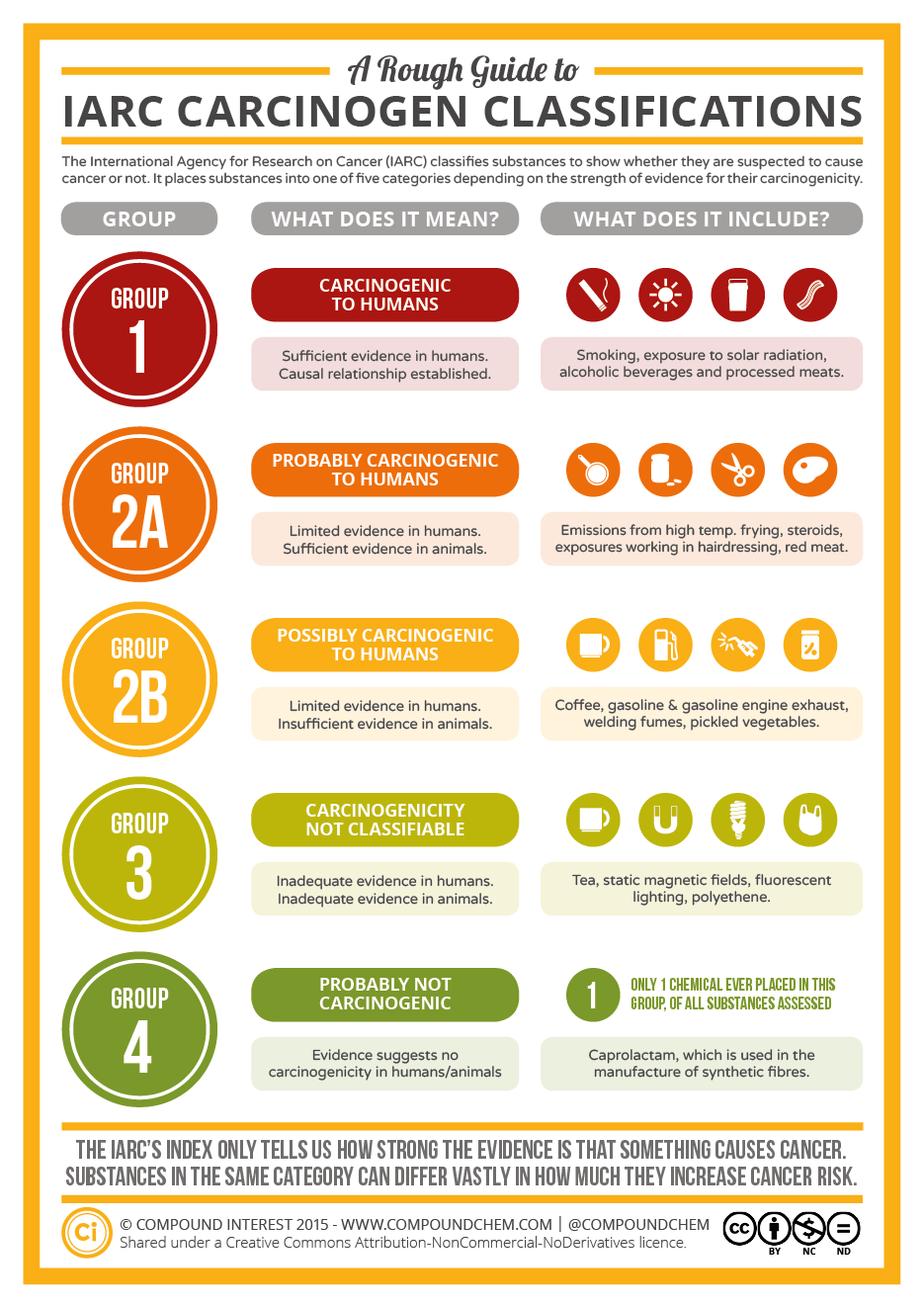
By including things classified under 2B - possibly carcinogenic to humans, this statement is a sneaky sleight of hand. Only the last two are listed under 2A - probably carcinogenic to humans. In order to clarify for you more, this chart from Compound Interest gives a quick overview:


 As you can plainly see the rankings are based on evidence of carcinogenicity - not on how carcinogenic something is. It's not really accurate to compare different substances, even those in the same ranking - the mechanisms by which they cause cancer, and the risk they pose are going to be unique to each.

None of this is reason to dismiss the classification of glyphosate as probably carcinogenic to humans. Unlike the regulatory bodies who continue to approve use of glyphosate based herbicides, the IARC looked at the independent science, instead of relying on unpublished industry studies to base their conclusions on - which is precisely why their conclusions differ and should be taken seriously. Not only that, being that glyphosate herbicides are now so ubiquitous, and our exposures continue to increase, having concern over the long term effects of such a thing is quite rational. We need to continue to scrutinize the science behind this pervasive chemical. It is prudent to do so given the current evidence - as well as the lack thereof. And yet...

It is evident that the confusion over these rankings is being amplified by Skeptics. In particular, the blog of computer programmer Mark Alsip, named Bad Science Debunked stands out. Mark aims to point out the 'hypocrisy' of the $39 billion dollar organic market by targeting the usual punching bags like Food Babe and Dr. Mark Hyman. While they are public figures and should be used to all sorts of scrutiny from the Big s Skeptics by now, Mark takes things a step further by pointing the finger at small business owners for their supposed hypocrisy.


Apparently he got into a twitter conversation over one of his blogs about Vani Hari. This Etsy store owner and organic farmer got sassy with him so he decided to hold her to the same standard he applies to Vani.

Aside from the ridiculous statement about glyphosate being poorly linked to cancer, I noticed Mark makes a blunder about the substance being referred to in that tweet. It's about 2, 4-D - not about glyphosate. Regardless, he still uses that tweet to rationalize using glyphosate as a comparison to an ingredient in Farm Fairy Crafts organic lavender calendula cream to point out their 'hypocrisy'. The caffeic acid present in tiny amounts in their organic rosemary and grapefruit seed preservative is listed by the IARC in category 2B as the evidence is limited in animals, and no evidence was available for humans.

As mentioned before, comparing even two substances in the same category doesn't work to clarify anything. Bacon and cigarettes are both in category one. You can't compare those two things any more than you can compare a substance that is naturally occurring in plants and a synthetic herbicide. I am still trying to figure out how this inane comparison helps anyone to become more science literate.

Does it really make Farm Fairy Crafts hypocritical for selling organic lavender calendula cream and tweeting about the IARC classification of an herbicide? Heck no. I just took a spin around their Etsy site and Farm Fairy Crafts lists their ingredients and origins, their farming practices and pretty much anything you'd want to know about their products...meanwhile, Monsanto Company, creator of Roundup brand herbicide and Roundup Ready seeds has spent more than $22 million on blocking labeling of their herbicide treated crops in food products. If we are going to hold people to the same standards, why not apply it equally to Monsanto or any of the other companies selling pesticides and genetically engineered seeds? The criticisms are not only myopic, but also begin to wear especially thin as seen in our second example.

This gem of a piece on the small business owner Dr. Ena Valikov - a veterinarian who also happens to have a degree in biochemistry and be a very vocal critic of the anti-organic crowd - is unintentionally hilarious in that Mr. Alsip totally missed the joke Dr. Valikov was making here. Note the date on the post:


This just so happened to coincide with the release of the film Jurassic World. As IMDB describes it:

"A new theme park is built on the original site of Jurassic Park. Everything is going well until the park's newest attraction--a genetically modified giant stealth killing machine--escapes containment and goes on a killing spree."

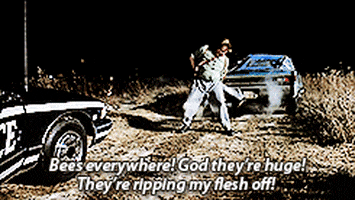
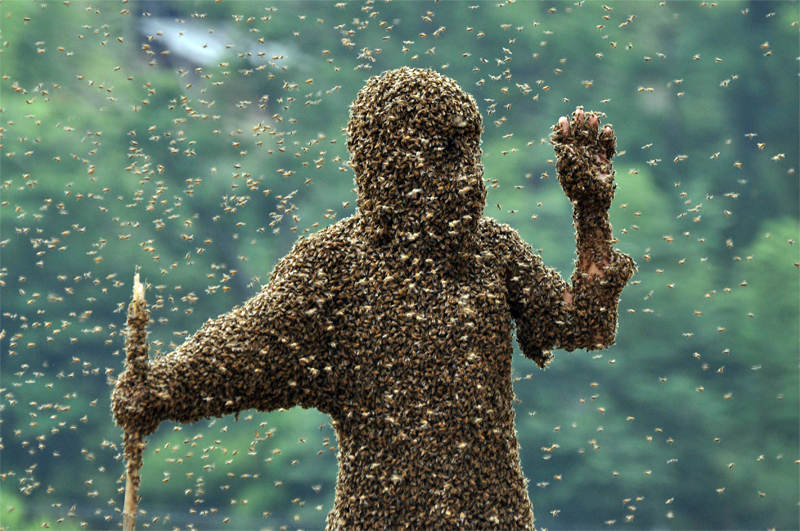
Now go back and look at Ena's post. The only thing Dr. Valikov is guilty of here is making a joke. I'm imagining killer bee/ants, ant/bees (bants?) attacking people like the scene in Tommy Boy where the cops pull them over...and I'm laughing about it. Well, your firearms are useless against them.


So far what we've learned from from Bad Science Debunked is that Etsy store owners are not allowed to talk about IARC rankings and veterinarians are not allowed to make jokes. How this will contribute to a science literate society, I'm still not entirely sure, but thank goodness Mr. Alsip is there to guide us. And troll us...


 and deny he has a product...


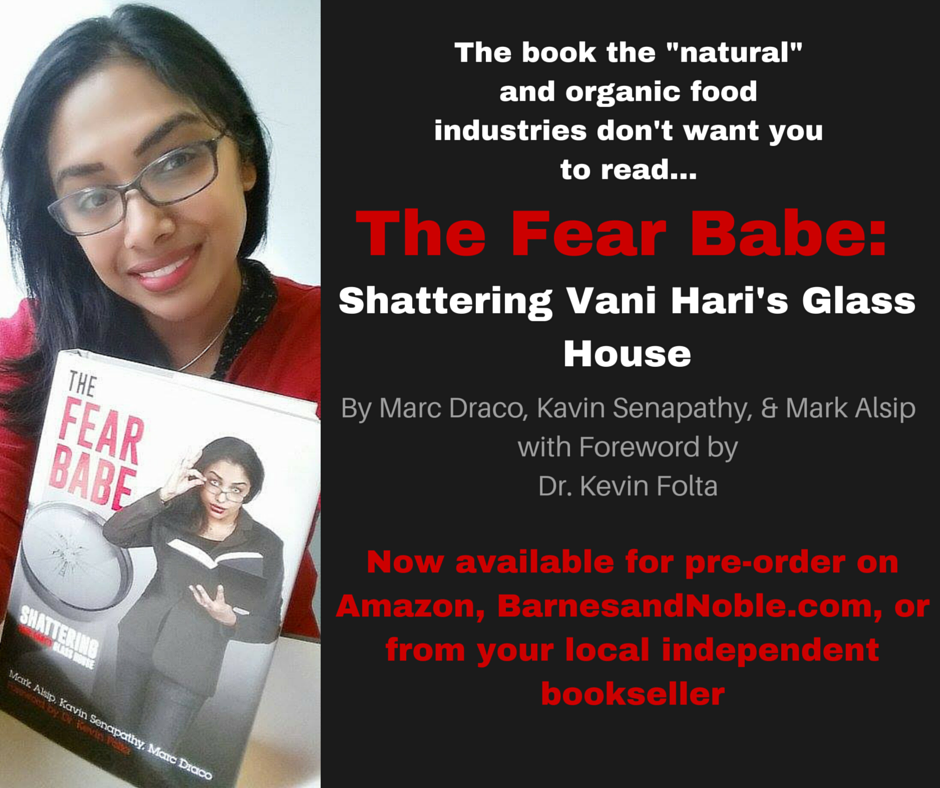
like this one...


which probably has a chemical in it listed by the IARC...


...but the bants are swarming again and I have to go make sure my perimeter is secure.


Until next time, ladies and gents!


DISCLAIMER:
Before you get your panties in a wad: All images and image captures are used in strict compliance with Title 17 U.S.C. Section 107 of United States copyright law (commonly known as “fair use law”). This material is free to the public and is intended to provide commentary, critique, and entertainment.

DECLARATION OF COMPETING INTERESTS:
1. I have purchased a product from Farm Fairy Crafts for personal use and received samples of the aforementioned organic calendula cream, and you know what? It's fucking fantastic. 2. My pets are not patients of Dr. Valikov's clinic, but we do follow each other on twitter and for the record, I think she has a great sense of humor.