Featured Post

5 Astroturf Groups You Should Stop Sharing From

After a hefty helping of inspiration from blogger Dawn's Brain's series on Facebook pages that people need to stop sharing from, t...

Saturday, November 5, 2016

Median Lethal Dopes

Here's a trend I'd love to see die. I can't go five minutes without seeing some snotty know-it-all whipping out the same argument every time someone brings up a concern with a food additive, or other substance. Most commonly though, it comes up when talking about the world's most ubiquitous herbicide.


Note the condescending attitude of commenters, and lack of understanding of LD50 amounts. The higher the dose, the less acutely toxic something is, which two of these fail to grasp - but we'll get into that more while we take a look at the memes that often accompany these types of comments.

Exhibit A:


Here we have naturally occurring compounds from two edible plants used as an insecticide, being compared to the active ingredient in a synthetic herbicide. Both capsaicin and allicin have documented health benefits and theraputic uses, and can be easily washed off of food. Glyphosate is the active ingredient in Roundup, a systemic herbicide formulation that contains proprietary ingredients to help it work better. It cannot be washed off.  The LD50 (lethal dose 50 or median lethal dose) is used to indicate how acutely toxic a substance is. In other words, how much it would take to kill you. This has nothing to do with chronic exposure, nor does it apply to chemicals with a non-monotonic dose response. This false equivalence theme continues with...

Exhibit B:


To view larger see the original chart in PDF form.


Here is a chart comparing the acute toxicity of numerous substances - salt, caffeine, pharmaceutical drugs, and pesticides, to riboflavin/vitamin B2. It was created by a lobbying group called Washington Friends of Farms & Forests, with two officers who just so happen to be Bayer employees.

Speaking of Bayer employees...


Exhibit C:


This is one I have addressed before in a previous post, Diluting The Truth. This is from Cami Ryan, Social Sciences Lead at the former Monsanto Co. Sarah Schultz of Nurse Loves Farmer referenced this chart as proof that "...the dose makes the poison. This goes for anything—not just pesticides used in agriculture!" Again, for the MILLIONTH time - this is simply not true for all substances. Sigh.

And now for...

Exhibit D:


No, genius, because Starbucks serves coffee to drink, not herbicide.

Seriously.

Exhibit E:


Photo by Compound Interest

This one is probably the most accurate, (even if virtually no one is eating apple seeds on purpose) however, it's like one puzzle piece rather than a full picture. It's not wrong so much as it's incomplete, and misused by Skeptics. Indeed, just because a chemical is present does not mean that it is harmful in the amount present, but that does not mean low levels of chemicals cannot be harmful, as in the case with lead or endocrine disrupting chemicals (EDCs). But Skeptics still try to fudge that picture up as much as possible - when they aren't just outright denying their existence or avoiding the topic. It should come as no surprise then that this particular graphic was commissioned by Sense About Science, known to champion chemical products while hiding ties to industry. It suits their agenda just fine, and Skeptics are more than happy to help them.

While writing this piece, I decided to search 'the dose makes the poison' on twitter, just to see if any other graphics came up. Lo and behold...

Exhibit F:


I typed the link on the photo into my browser and came up with a review article discussing the pros and cons of phytoestrogens (plant estrogens) on human health. 'Science Mom' Mommy PhD has badly misrepresented the information in this review in her graphic. For instance, the authors state regarding the difference in public attitudes toward synthetic EDCs and phytoestrogens: "Source, rather than evidence for effects likely contributes to this incongruous attitude." This does not jive with her quote at the bottom of the graphic. The words 'likely contributes' does not mean 'the foundation for' last I checked. The authors in the review go on to say "The 1999 approval by FDA of the health claim that daily consumption of soy is effective in reducing the risk of coronary artery disease has undoubtedly cemented the idea in the minds of many that soy is beneficial for human health." Basically, the general public's attitude toward phytoestrogens has a lot more to do with the health benefits being touted - not purely a naturalistic fallacy which she implies here. Not only that but the graphic is taking what the review said about phytoestrogens and applying it equally to synthetic EDCs making it seem as though the risk is the same from either one when that's not what was said at all. I'll tell you what's really incongruous - Mommy PhD's ahem, creative interpretation of her citation for this picture.

The fact remains, that acute toxicity, sub-lethal harm, chronic toxicity, dose, timing, sequence, vulnerable populations, and many other factors make this a complex discussion that can't be boiled down into a meme. Even so, I doubt that Skeptics will lay off this logical fallacy any time soon, as this is one of their core arguments. It would be in their own best interests though, as this gross simplification only serves to shine a giant spotlight on their scientific illiteracy in this matter.


Tuesday, October 25, 2016

'Reasonable' Rhetoric

The ladies at Independent Women's Forum are out in full force with a new campaign - it's called 'Reasonable Moms'.


I've heard mumblings about it for a little while now, but other than a pretty broad statement about parenting pressure and guilt, with some pointed rhetoric thrown in, the Reasonable Mom movement seemed pretty tepid at first. I definitely had my suspicions about the underlying motives of this project, which turned out to be correct.

After the scheduled event in Washington, IWF tweeted a link to their project's 'fact' sheets. My head promptly exploded.


These 'fact' sheets are on three topics: BPA, GMOs, and Food Dyes. Let's take a look, shall we? 

First up, the sheet on BPA. According to the NIH Bisphenol A (BPA) is "a chemical produced in large quantities for use primarily in the production of polycarbonate plastics and epoxy resins." BPA use is expanding since it's introduction to the marketplace in the 1960's - 10 billion pounds were produced worldwide by 2012, and the estimated market value reached over $13 billion in 2013. The market is predicted to grow by about 5% annually. BPA is big business.

Though originally discovered in the late 1800's, BPA renewed interest in the 1930's when scientists were looking for a drug to treat miscarriages and menstrual problems. Despite its estrogen mimicking effects BPA fell to the wayside in favor of the more potent DES, now banned from use due to increased rates of reproductive diseases and cancers from exposures in utero. BPA began to thus become widely used in consumer products like plastics and in canned food linings. Like most of the 80,000 chemicals on the market, under the law there is no requirement to do comprehensive safety studies. And if you had any doubts about the ineffectual framework in place, the EPA has still yet to be able to ban asbestos. 

Yes, you read that right. 

Many studies have shown negative health effects from BPA. The majority of independent studies in particular have shown harm - contrasting starkly with industry studies conclusions. From a report in Newsweek:

"One 2006 analysis by vom Saal and Wade Welshons showed that 11 out of 11 industry-funded studies found BPA had no significant action, while 109 of 119 studies that had no industry funding (92 percent) did find effects of BPA."

An independent review of the literature in 2013 found 'strong links exist between early exposure and altered behavior and asthma in children.' An expert scientific panel concluded that 'The published scientific literature on human and animal exposure to low doses of BPA in relation to in vitro mechanistic studies reveals that human exposure to BPA is within the range that is predicted to be biologically active in over 95% of people sampled. The wide range of adverse effects of low doses of BPA in laboratory animals exposed both during development and in adulthood is a great cause for concern with regard to the potential for similar adverse effects in humans.'

A review by scientists from 2008 concludes in part that "The data collected thus far in the field of environmental toxicology are sufficiently robust to raise concerns about the potentially deleterious impact of endocrine-disrupting chemicals on human development." We have many, many more studies supporting this statement now.

From Vandenberg and Prins in Andrology 2016: "...more than 100 epidemiology studies suggest associations between BPA exposures and a range of conditions and diseases, including metabolic syndrome, infertility, and severity of asthma..." The authors address the controversy surrounding BPA, saying that "one factor that cannot be ignored is the role of ‘manufactured doubt’, a concept that was originally invented by representatives from the tobacco industry to generate scientific debate about issues that were relatively well settled solely for the purpose of shaping public opinion and delaying regulatory action...It has been suggested that the chemical industry, as well as trade manufacturing groups, has used similar tactics to keep harmful EDCs, including BPA, on the market, long after scientific inquiry has identified their potential to cause harm (Bergman et al., 2015; Oreskes et al., 2015)."


Funny they should mention that. The IWF fact sheet on BPA reads like it's coming directly from a chemical industry sponsored website. They make the claim that 'people simply don't come in contact with high enough levels of BPA through the use of everyday products and consumables for it to impact the human body.' But our bodies respond to tiny doses of hormones down to the parts per trillion level, and hormone mimicking chemicals do not follow a linear dose response pattern. This should come as no surprise to those familiar with IWF though - they deny the science around endocrine disrupting chemicals just like they deny the science supporting climate change.


IWF also makes the claim that many health and safety regulatory agencies have 'concluded that BPA is safe.' First on the list is the World Health Organization. From an expert meeting report by WHO and FAO:


I guess they are counting on people being too lazy to look? The fact sheet has zero citations, and the best part - they tell you to 'check out these good sources for more reliable information':


First they list SciBabe, an ex Amvac Chemical Corporation employee. Second, we have one of the Science Moms. And third we have Angela Logomasini, an IWF contributor and Director of Risk and Environmental Policy at the Competitive Enterprise Institute. Last, but not least is the group you think of first when it comes to corporate astroturf, American Council on Science and Health (whose name they get wrong, a common theme as you'll see in a moment.)
President of ACSH at the Reasonable Moms event with that dude that keeps calling me an 'organic shill' on Twitter, Julie Gunlock from IWF,  Jenny Splitter - another 'Science Mom', and Jamie Wells of ACSH.
Right on the heels of this event was an article in the Federalist (badly) written by Julie Gunlock criticizing the work of Leonardo Trasande, and associate professor of Pediatrics, Environmental Health and Population Health at NYU School of Medicine.


Trasande with two a's was interviewed recently in the press about a new study he published that assessed the cost of health problems associated with exposure to endocrine disrupting chemicals. Julie attempts to smack down those reports with her article, hilariously misspelling voilà as 'VIOLA' along with the name of the man she is disparaging, as 'Trasende' throughout the piece. But more importantly her critique lacks any credible evidence to back it. She's all over the map, from cancer to bisphenol A, Environmental Working Group (EWG), organic food, 'correlation does not equal causation,' and even goes so far to accuse Trasande with two a's of fabricating data in a prior study. Yet, she never really addresses the new study itself or gives any reasons as to why it is 'junk science' as she states. She ends with:

"The scientific community must do more to reign in activist scientists and dubious scientific studies that create fear and alarm where no documented danger exists."


Rough translation: This type of research threatens industry, and all we can do to stop them is attempt to libel them in shitty articles like this. Fuck my life.

Look, I don't know for sure who butters their bread over at IWF, but you can usually get a pretty good picture from what they are pushing in their campaigns. The other two fact sheets on GMOs and Food Dyes read about the same as the BPA one, with no citations, dubious references to astroturf and junk science industry front groups, and loaded language meant to persuade mothers that they are UNreasonable by being concerned about the effects of these things on their children's health.

 
Oh noes! Not the CHEMOPHOBES. Say it isn't so!

Like we are supposed to think they give a fuck about the earth?


In reality, there exists plenty of evidence that these things may not be as safe as the people selling them may want us to believe, and given the state of the current science, taking a precautionary approach is in fact a very reasonable position.

Bottom line advice for moms: don't let IWF or other front groups tell you how to parent, or define what being reasonable is.


Saturday, August 6, 2016

Censorship or Consequences?

On today's episode of Degrassi Junior High, a tempest is brewing at the Skeptic table over the removal of a Facebook page called We Love GMOs and Vaccines, which describes itself thusly;

"We are an organization devoted to promoting biotechnology and exposing those who wish to demonize it."

The page owner, Stephan Neidenbach is claiming his page has been censored via Facebook reporting. There is no way to know exactly who made reports or how many people made them. It seems the page was removed and then restored a few times prior to Facebook finally deleting it due to the number of reports.


This has led to a concerted attempt to get Facebook to restore the page under the assumption that it's being 'censored'.


Steven Novella from Skeptic's Guide to the Universe and Science Based Medicine has come to the defense of WLGV in a new blog post.

Recently the Facebook page, We Love GMOs and Vaccines, was permanently taken down by Facebook and its founder, Stephan Neidenbach, was banned from Facebook for 30 days. What offense did he commit to warrant such draconian treatment? None. He was simply using a Facebook page to promote a pro-science and skeptical attitude toward GMOs and vaccines, specifically to counter the gross misinformation about these technologies by anti-science fringe groups.

If you are going to defend someone and write a piece supporting them, best do some homework first and make sure that support is well placed. Shall we, then?

Is WLGV really some innocent babe in the woods, just trying to promote 'a pro-science and skeptical attitude'? Mr. Neidenbach has already accurately described his own behavior leading up to the removal of his Facebook page here in this now deleted blog titled dramatically; 'The Image That Brought The Queen of Anti-Vaxxers to Her Knees'. Lucky for us, it's in an online archive and you may view it in its entirety here.

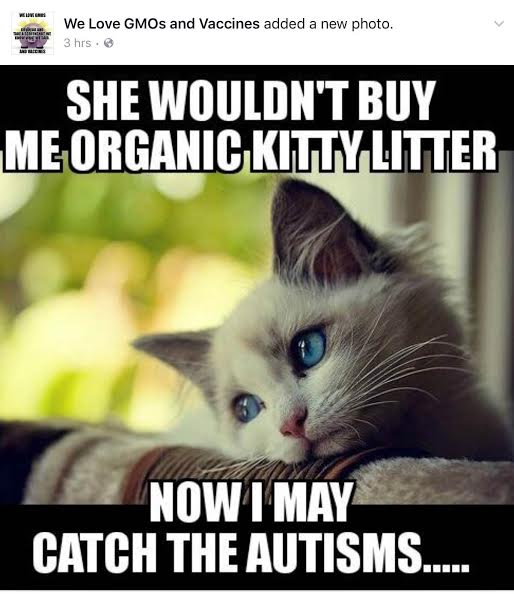
This is regarding Erin Elizabeth, (girlfriend of Dr. Joseph Mercola) who runs a Facebook page called Erin at Health Nut News. Stephan describes how he attempted to 'bait her into action' with this insensitive meme making light of the suicide of Dr. Jeff Bradstreet.

Again, a day before the blog post was published Neidenbach is seen here bragging on Twitter about baiting Erin Elizabeth to Steven Novella's Science Based Medicine co-contributor David Gorski (@gorskon):


Note too, that Neidenbach references how he got around having his personal account put in time out:

"The image was unpublished by Facebook some time over night. Fortunately I used an alternate account to post the image, so my personal one was not put in time out by the Facebook “bots”."

He admits to using a sockpuppet account so he would not have to face the consequences for posting content that would be reported for violating Facebook community standards (the Bradstreet meme). This sounds like someone who knows full well what he is doing.

At some point after this the WLGV page was removed, presumed by WLGV admins to be by followers of Erin at Health Nut News. This led to one page admin asking for help from Kevin Folta.

Kevin advised them not to retaliate, and ended up having a dialogue with Erin Elizabeth. It resulted in Folta publishing a chastising blog post about the incident.


At first, it seemed as though the WLGV admins were taking his advice regarding frivolous reporting.


But it didn't last long.


Now, as far as Novella's claim that Neidenbach was 'simply using a Facebook page to promote a pro-science and skeptical attitude toward GMOs and vaccines', I present to you a sampling of WLGV posts made in between sharing other Skeptic blogs and links to American Council on Science and Health and Forbes articles:

Making autism a punchline

Accusing sick people of faking for attention

In case you thought the first one wasn't clear...

Comparing people to Stalin and Hitler


Page founder encouraging fraudulent negative reviews in GMOLOL

And on WLGV


A new grocery store opens near you. What do you do? Destroy them, of course!


Did he even step foot in the store? Who knows...

Targeting Laura Krantz who wrote about Calsetous Juma's ties to industry in the Boston Globe.


Still here? Great, there's more!


Comparing GMO labels to Holocaust badges

Targeting Joseph Norman, postdoc at NECSI and co-author of the Precautionary Principle (with application the the Genetic Modification of Organisms)


Trolling the online Lyme community.

Edited to add the location in addition to the full name of organic farmer and Etsy shop Farm Fairy Crafts. WLGV doxxed them multiple times on Facebook as well as on Twitter.


The idea that WLGV was much of a science communication page to begin with, is a hard stretch of the imagination. They encouraged trolling and going after pages they did not like with negative reviews, and they frequently made personal attacks on people that the page creator, Neidenbach disagreed with. He even went so far as to create a 'Derp of the Month' series on the WLGV website to target individuals he does not like.


When Joan's daughter (naturally) defended her mother on Twitter, Neidenbach complained that Facebook had 'censored' him.

"The daughter of a quack peddling a juice diet to cure cancer, who I wrote about last week decided to take to Twitter in an attempt to “report” me. Apparently she finds it offensive that I called out her mom for encouraging people to starve themselves free of cancer. Since many groups hostile to science have a habit of attacking teachers, I made the graphic above as a hyperbole. The Zuckerberg bots just saw the flags and put me on a three day Facebook time out and removed the image."


None of this is science communication, clearly. So let's just put that to bed right now.

However, is this truly censorship as is being claimed?

Facebook is a free service - when you sign up, you agree to their set terms of service and community standards. Any violation of community standards will be removed. Facebook relies solely on reports to bring content in violation to their attention.


If WLGV were in violation of these standards or not was up to Facebook to decide - and decide they did as part of the agreement entered into by both parties. And whether or not there was a coordinated effort to report the page, one can begin to see that the page incited this type of back and forth. It really should come as no surprise to them that people eventually got tired of being a punching bag for the amusement of the page admins and their followers.

Despite this pattern of behavior, the Skeptics are out in full force defending the honor of their club members, all in the name of "free speech" and science. At the moment there have been several articles written aside from Steven Novella's mentioned at the start.

Kevin Folta: 'Silencing Unpopular Thought with Swarm Complaints',
Genetic Literacy Project hosted two: Science Communicators Condemn Facebook's Censorship of Pro-Science "We Love GMOs and Vaccines" and Stephan Neidenbach's account: Facebook bows to anti-science activists, shuts down ‘We Love GMOs and Vaccines’

Erin Elizabeth who had her page removed shortly after WLGV was deleted gives her account here: The Trolls Took My Page Down, We Won't Be Silenced and This is How to Get My Page Back Up 

In response to Health Nut News' removal, both WLGV and Chow Babe have unpublished their pages in protest of the situation.

Look, your Facebook page was removed. Your brother's scooter was not trashed by Hubie Pyatt, Mr. Pyatt did not try to molest you in the office, and you are not an 80's movie character - no matter how bad you want to be.


Not that I blame you for trying. But, maybe instead of all this drama of reporting pages, unpublishing pages, shouting censorship! with righteous indignation and grandstanding, perhaps people could oh, I don't know, start acting their age and be accountable for their online behavior?

Maybe if you have a page that says you 'love' something, you should promote that love instead of promoting hate for people who don't love the same exact things, the same exact way you do?

I know that's too much to ask for a lot of people, just like being sure that you if you are going to defend someone publicly that you first be sure they are not actually a bunch of immature cyberbullies who played a stupid game and are now stomping their feet crying because they don't like the consequences of their own behavior.

Do You Suffer From Chemophobia?

Have you heard? A great affliction is sweeping the globe! According to sources, a significant portion of the public is suffering from 'chemophobia' - being defined as an irrational or extreme fear of chemicals. Chemophobia is rampant and it threatens each and every one of us...or does it?

The way the word is being used, you'd sure think so.


I unfortunately did not have the pleasure of watching this ACS webinar,  but I think by taking a look at James Kennedy's blog, we can get the gist of what he was teaching there. Some of it I think is great and totally agree with - whereas other parts - not so much.

For instance, JK starts out strong:

"I ask all chemists to embrace the dictionary definition of ‘chemical’ and stop bickering with the public over definitions."

I absolutely agree that picking on people for using the colloquial term chemical is a waste of time, it will only serve to further polarize and makes you look like a jerk.

Now here is where things get hairy, as James goes on to define 'chemophobia':

"‘Chemophobia’ is an irrational aversion to chemicals perceived as synthetic.

The word ‘chemophobia’ refers to a small subset of people who are not only disenfranchised by science, but who have subscribed to alternative sources of knowledge (either ancient wisdom or – sadly – Google). Many people with chemophobia are protesting against the establishment, and this is particularly evident in the anti-GMO movement. At the core of most people who oppose GMOs is a moral/political opposition to having their food supply controlled by giant corporations. No number of scientific studies concluding the safety and reliability of GMO crops will succeed in persuading them otherwise because the anti-GMO movement is founded on moral/political beliefs, not on science. By throwing science at them, we’re wasting our time."

By using the word 'irrational' in defining chemophobia, it invokes a particular feeling. Irrational is defined as 'not logical or reasonable'. He then goes on to state that it refers to a small subset of people and uses the 'anti-GMO movement' as an example.

Mr. Kennedy has now entered weapon word and Celeber Cavilla Fallacy territory.

The Celeber Cavilla Fallacy

In one fell swoop, James has painted anyone who questions the use of genetic engineering and  companion industry chemical products in agriculture, as not just irrational, but unworthy of even being dignified with your time. Neutralized.


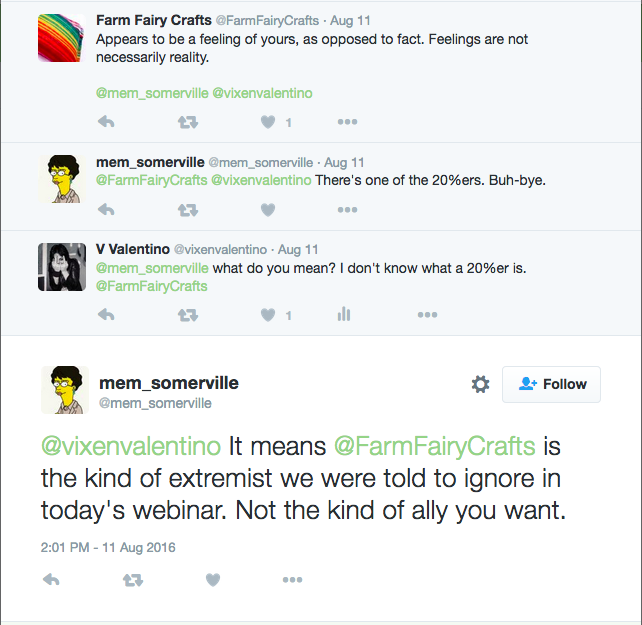
In the third section of his blog, James shares where the 20% figure comes from: The Royal Society of Chemistry’s report on Public Perceptions of Science polled just over 2 thousand people over age 16 on their perceptions of chemistry. So, using the results coming from this informal poll, Kennedy draws some conclusions.

"No matter how the RSC phrased the question, roughly 20% of the UK public who were surveyed indicated a negative attitude towards chemistry, and another 20% showed a positive attitude. The 60% in the middle felt disconnected from the subject – maybe disliked it in school – but felt neutral towards it when asked."

He then goes on to add:

"Chemophobia afflicts some people in the bottom 20%. They gave negative word-associations with ‘chemistry’ (e.g. ‘accidents’, ‘dangerous’ and ‘inaccessible’). That bottom 20% group is so vocal (e.g. Food Babe) that they distract chemists from the 60% in who are neutral. The ‘neutral’ crowd is a much larger audience that’s much easier to engage/persuade through outreach efforts. We should focus on talking to them."

Kennedy isn't clear about exactly how many he deems afflicted with 'chemophobia' - he just says it 'afflicts some' in the negative 20% - and then uses Food Babe as a scapegoat, I mean, an example.

He sums up his blog post with the idea that focusing on the 'neutral' majority is where chemists need to focus their efforts, and that if things go as planned, that the public may help them out in the fight against the enemy of 'chemophobia'.

"By engaging those who feel neutral about chemistry, we might even empower enough of the public to fight chemophobia (online, at least) by themselves – without our direct intervention."

Now, despite not having personally viewed the webinar, I was lucky enough to be apprised of some of the highlights by my good friend mentioned above, Ms. Mary Mangan who tweets as @mem_somerville.  Credit goes to her for sharing all these lovely slides! Piecing this together with James Kennedy's blog post, we can get a better idea of what was being taught there.


While I agree that more science and chemistry education for the public is important, and that chemistry needs their own Brian Cox or David Attenborough, and that there are some very valid points being made here, what I can't abide is the use of pejoratives and (tired, played out) scapegoats.

Like a kid whacking at the same piñata for an hour... Seriously. Getting REALLY OLD, people.


The general public has every right to question the safety of manufactured chemicals without being described as extremists. At this point in time, the chemical industry has no one to blame but themselves for the lack of trust their unsafe products have inspired in consumers. Given that the testing and regulation of new chemicals is a joke, and the once 'safe' but now banned chemical list keeps growing, people are skeptical of manufactured chemicals for good reason. One very recent and egregious example is the trouble with perfluorinated chemicals, also known as PFCs for short.

An excerpt from a New York Times article about Rob Bilott, the lawyer who took on an environmental lawsuit against DuPont.

"DuPont pumped hundreds of thousands of pounds of PFOA powder through the outfall pipes of the Parkersburg facility into the Ohio River. The company dumped 7,100 tons of PFOA-laced sludge into ‘‘digestion ponds’’: open, unlined pits on the Washington Works property, from which the chemical could seep straight into the ground. PFOA entered the local water table, which supplied drinking water to the communities of Parkersburg, Vienna, Little Hocking and Lubeck — more than 100,000 people in all."

Bilott, speaking on the thousands of Dupont documents he went through for the case:

"DuPont had for decades been actively trying to conceal their actions. They knew this stuff was harmful, and they put it in the water anyway."

Chemophobia? To this I say please, dear chemical industry - GFY.