Featured Post

5 Astroturf Groups You Should Stop Sharing From

After a hefty helping of inspiration from blogger Dawn's Brain's series on Facebook pages that people need to stop sharing from, t...

Friday, February 10, 2017

Fake Skeptics Spread Fake News About Rachel Carson

I receive Google alerts for several subjects, and I like to play 'guess who wrote it?' when I see an absurd headline. Most of the time I have a pretty good idea. For instance if it's a Forbes headline trashing organic agriculture, it's almost a sure bet that Henry I. Miller is behind it.

So when a Daily Beast article showed up entitled, 'How Rachel Carson Cost Millions of People Their Lives' I wasn't exactly shocked. It's a trope I've heard a zillion and a half times before, usually from Uncle Henry's alma mater the American Council on Science and Health and other industry stooges. 

Imagine my surprise to see that it was from the well known champion of public health, Paul A. Offit. Paul is the Director of the Vaccine Education Center at the Children’s Hospital of Philadelphia as well as the Maurice R. Hilleman Professor of Vaccinology and a Professor of Pediatrics at the Perelman School of Medicine at the University of Pennsylvania according to his bio. This is a man who is promoted frequently in the media as an expert, and he's a huge fan favorite of the Skeptic crowd as well. I've personally read his book Vaccinated: One Man's Quest to Defeat the World's Deadliest Diseases about Maurice Hilleman, and taken his vaccine course online so he is someone I am familiar with. I expect a lot of things from Dr. Offit, but this article in the Daily Beast was not among them. 

The opinion piece contains zero citations, and even a simple Google search can show you how many of the claims made are flat out false. Like, in regards to India, Sri Lanka and South Africa for example. 

The publication of this article did lead to a couple of responses, and this one had a very concise rundown of the issue for those who may not be familiar:

"the short version of it is that
a) Carson did not call for the complete ban of DDT when it could save people’s lives,
b) The U.S. ban on DDT in 1972 did not include other nations, where malaria was actually killing people, many of which never did ban DDT,
c) her actual argument was not that chemicals should not be used to kill insects, but rather that the unregulated spraying of them everywhere all of the time had massive ecological consequences that would affect humans negatively too,
d) mosquitoes were becoming resistant to DDT by its ban in 1972,
e) much of the rise in malaria in the developing world in the 1970s had to do with decreased anti-malaria expenditures by governments,
and f) DDT is still frequently used in the developing world." 

The same article links to a post from Yale Environment 360 that touches on the matter more in depth. Also recommended is the book Merchants of Doubt which addresses the subject of DDT in one of the chapters. 

Despite the information Offit espouses having no merit whatsoever, as well as already having been very widely refuted - this did not stop the Skeptic community from sharing it. To be sure, there were dissenters, and they deserve to earn their points for this. Mark Hoofnagle being one, as well as David Gorski who has written about DDT before. Some remained conspicuously silent on the matter, while others just uncritically shared the article - presumably because of who the author was. 


Skeptic's Guide - 851 shares


Sci Babe shared from SGU - 183 more shares

Skeptoid Podcast's Brian Dunning doubles down on his ignorance and contributes 54 shares


That's over 1000 shares of pure bullshit posing as evidence-based fact. To put it in the common vernacular - it's fake fuckin' news! So how ironic then, that it should be shared by those who claim to promote evidence and science and condemn fake news.


SciBabe aka Yvette d'Entremont is even going to be giving a lecture about fake news at the American Chemical Society's national convention soon.


Are we really supposed to take these people seriously when they yammer endlessly about evidence and reason and critical thinking, and then demonstrate such an egregious lack of applying it to themselves?

A convicted felon, former pesticide co. employee, a cow, and a potato walk into a bar...


Rachel Carson once said: "We live in a scientific age, yet we assume that knowledge of science is the prerogative of only a small number of human beings, isolated and priestlike in their laboratories. This is not true. The materials of science are the materials of life itself. Science is part of the reality of living; it is the way, the how and the why for everything in our experience."

Her words don't ring any less true today.


Saturday, January 14, 2017

Useful Idiots

A term generally used in politics, a useful idiot is defined by the Oxford Dictionary as

(Originally) a citizen of a non-communist country sympathetic to communism who is regarded (by communists) as naive and susceptible to manipulation for propaganda or other purposes; (more widely) any person similarly manipulable for political purposes.

The latter part of the definition makes it a suitable term for the throngs of people commonly referred to as 'trolls' by many, also referred to as 'shills' and probably some other colorful terms I've missed. I think that the term troll is often accurate, though not everyone disagreeing with you is necessarily an internet troll. 

The word shill gets thrown around far too often and far too carelessly. It's a term I avoid using, personally. Making accusations without proof is never advisable, and it's also committing an ad hominem logical fallacy which is always guaranteed to make you look a bit foolish. There are much better ways to get your point across in a debate. 

There is also a common misconception that there are hordes of people on social media paid by various industries simply to troll and argue with people. I think this widespread idea is a very human response by people who simply cannot fathom why someone would spend time defending companies with such horrific documented harm to people and the environment. That they must be compensated for it seems the likeliest explanation - but I've seen no evidence (yet) to back this claim. I do think that we have plenty of evidence for another explanation however...

The Useful Idiot.


March Against Myths About Modification, not funded by industry, yet very useful to them.


From the evidence that I have seen there is definitely a concerted effort on the part of industry to control information about their products and business practices. Environmental activists have done such a good job of getting their message out, that industry has needed to hire PR firms to help them influence public perception, particularly on social media. 

A perfect example of this being how the agriculture industry has hired infamous PR firm Ketchum (who run the website GMO Answers) to disseminate a positive message about their products, genetically engineered crops. Sites like this along with other astroturf groups and academics with industry ties and conflicts of interest are at the top of the pyramid, spoon feeding propaganda dressed up as 'science' and 'evidence' to our good friends, the celebrity Skeptics. They in turn happily disseminate this information to their large number of followers. The way that these fake skeptics operate has been thoroughly detailed, so I won't get too into that here. The Skeptics of course have innumerable blogs, websites, Facebook pages and Twitter accounts with which to share the information they are getting from 'experts' and recycling among themselves. This is social engineering at it's finest. 


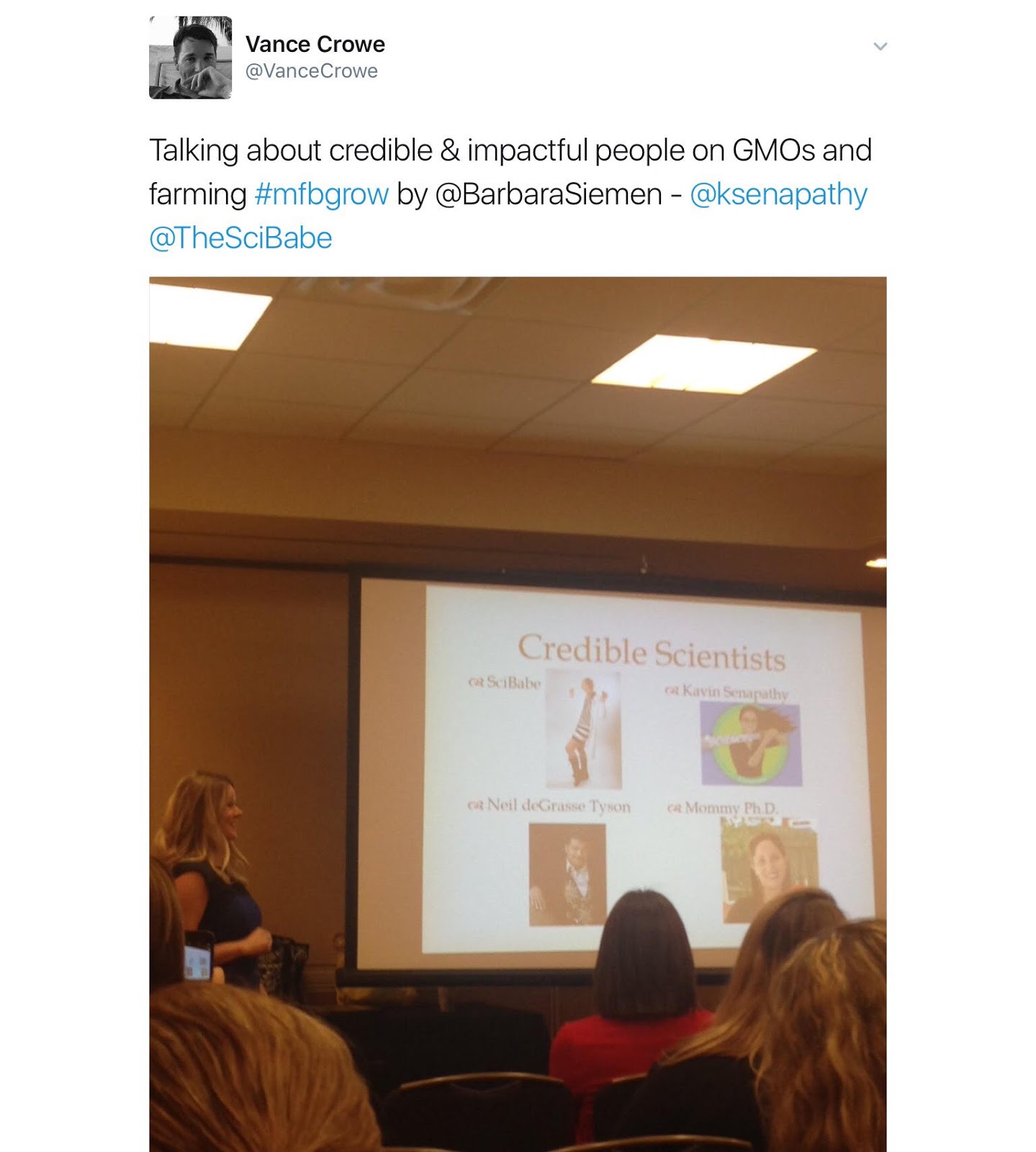
Monsanto's Director of Millennial Engagement (PR guy), Vance Crowe shows the plan to 'outcompete fear of modern ag' by 'connecting tribes'.

Industry is aware of this, and isn't even secretive about fully exploiting these social and political networks to their advantage as is illustrated in the above photo. This is one of the tactics used by the father of public relations, Edward L. Bernays. From his obituary in the New York Times, "He helped shape public relations by favoring the use of endorsements from opinion leaders, celebrities, doctors and other "experts" to strengthen the arguments his clients wanted to make. In addition, he favored surveys, releasing the results of experiments and polls to make a better case for his clients' positions and products."

L-R clockwise: a former chemist, not a scientist, a #ScienceMom, and a celebrity astrophysicist.  

It doesn't just stop there, though. The 'Bad Guys' or 'Evil People' as some have called them, are endlessly pointed out and pilloried. The formula is simple enough, find someone with notoriety who runs afoul of your message, and hold them up as an example of why the world is going to hell in a hand basket.

Kevin points out the 'Evil People' It's all their fault!

And now that the message has been disseminated from the top, it continues to filter down to the general populace from Useful Idiots who have wholeheartedly and unwittingly bought into the propaganda.

Val Bayes, Monsanto's STEM Education Lead, 'A Science Enthusiast' sticker, and Vance Crowe's hand.


And boy, do they love it when that happens. The more oversimplified the 'meme' or message, the better.

Ermahgherd!

Because, honestly, what's better than a gaggle of indoctrinated, mindless automatons who spout one-liners at the bad guys on social media for you? Ones who do it for FREE. 

This is clearly social engineering. A bit more nuanced than the simplistic 'paid trolls' notion that many espouse, though with considerably more evidence behind it. This is not to say that there are not people paid by industry to deliver their message, or that people are always up front about money they may be receiving directly or indirectly from corporate entities. But the idea that Monsanto or any other Ag company is paying all those people to disagree with you and troll your posts on social media or that they get paid by the comment, or post or whatever, is basically unfounded. As I have just demonstrated (and there's lots more where this came from), they don't have to!


Tuesday, January 10, 2017

The Risk Monger's Deceitful Dozen

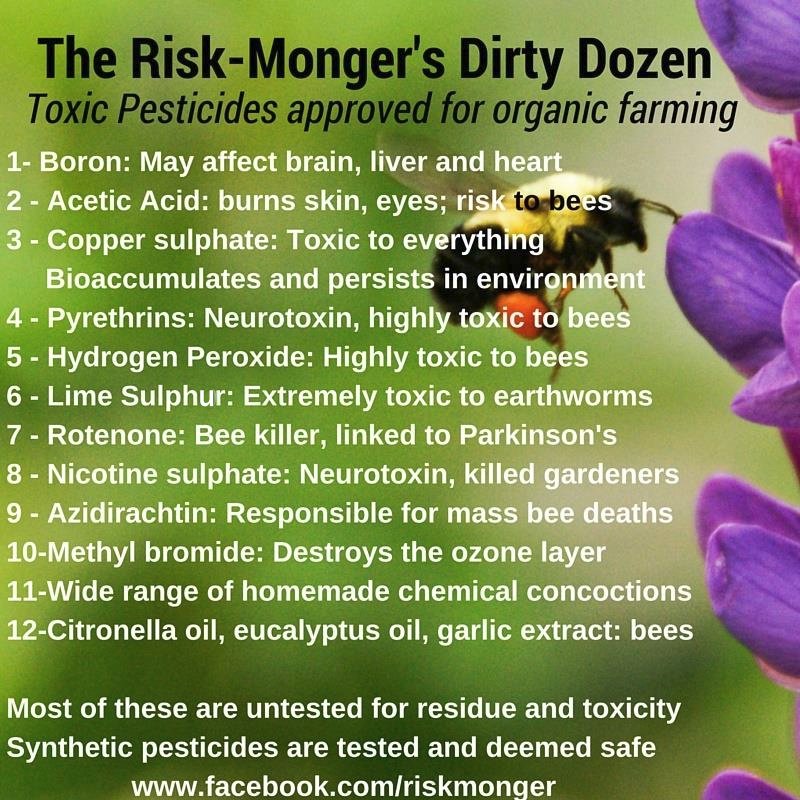
Another popular meme being distributed by Skeptics crossed my path yet again today, called the 'Risk-Monger's Dirty Dozen' and I thought it was time to address the claims being made therein. The Risk-Monger is David Zaruk. He's a prominent voice on social media, a former employee of Solvay, a global corporation with divisions in pharmaceuticals, chemicals and plastics and a part of the team that set up GreenFacts Foundation, initially funded by Solvay.


This is a stunning example of disinformation and propaganda, and I'd like to just dissect each numbered claim for a broader understanding of why that is so.

Let's begin!

1. Boron 


First of all, boron is an essential nutrient for plants and naturally occurs in soil. Like anything, it may be harmful in high doses or if misapplied, but organic farmers aren't just flinging this stuff around willy nilly. See here for an example of how it's used.

2. Acetic Acid


It's fucking vinegar. Do I really need to expound upon this one? Don't spray it in your eyes or on bees, for fucks sake.

3. Copper Sulfate


One of a few synthetic substances approved for use in organic farming, copper sulfate is definitely not being used indiscriminately due to copper's ability to build up in soil as well as being toxic in high amounts. No farmer is using this or any other input unless clearly needed, and there are steps that must be taken to minimize risk. Soil testing is required when using copper, for example. As far as being 'toxic to everything' - that is highly misleading, since while copper can be toxic in the wrong amount it is also an essential nutrient for plants, animals and humans. This is definitely not a first resort tool in crop production due to the important balance that must be kept. It is also permitted in conventional agriculture right along with all other organic approved substances, lest we forget.

4. Pyrethrins


Pyrethrins are a naturally occurring insecticidal compound found in chrysanthemum flowers. This is not to be confused with pyrethroids, a synthetic analog of pyrethrins. According to NPIC, "Pyrethrins are practically non-toxic to birds but highly toxic to honey bees. However, some of the risk to pollinators is limited by their slight repellent activity and rapid breakdown." Clearly, pyrethrins need to be used with care and applied correctly so that they do not harm bees. Neurotoxicity can be a concern with occupational exposure, safety instructions need to be followed precisely. Any residues on food would be minimal, and easily washed off. Pyrethrins do not spread readily through a plant in the way neonicotinioids were designed to do.

5. Hydrogen Peroxide


Hydrogen peroxide (H2O2) is another substance approved for organic farming. It is allowed to be used as a disinfectant and for plant disease control. H2O2 breaks down readily into water and oxygen. Direct contact is highly toxic to bees, however as long as care is taken not to spray during active foraging times, and prevent drift, once residues have dried they are considered non-toxic. Proper care needs to be taken when handling concentrate, but again, once dry the application is considered harmless to human health.


6. Lime Sulfur


Lime sulfur is a modified form of elemental sulfur. Elemental sulfur is considered to be non-toxic to birds, aquatic organisms and honeybees. Sulfur is an essential macronutrient in crop production, it is allowed for use as a soil amendment, and for diseases, mites and insects in both the elemental and lime sulfur forms. High applications can reduce soil ph and thereby negatively effect earthworms, however the claim that it is 'extremely toxic to earthworms' is without merit. Clearly it is in the best interest of the farmer to protect soil from shifts in ph thereby protecting soil biology, including earthworms. Elemental sulfur is relatively harmless to humans, while lime sulfur is extremely caustic and must be handled properly when used in agriculture. Again, no one is flinging this shit around.

7. Rotenone

Source

Not fucking used.  Really.

Not even on fucking imported produce either.


8. Nicotine Sulphate


It's also fucking prohibited!


9. Azadirachtin


Another name for neem oil or neem oil soap, azadirachtin (misspelled on the meme as azidirachtin) is approved for use in organic farming. It is derived from Azadiracta indica, the neem tree. It has been used for hundreds of years for medicinal purposes, as a cosmetic and as a pesticide. Azadirachtin breaks down quickly, approximately 4-5 days. Thus it is not expected that it will accumulate, and is considered relatively safe to wildlife and adult beneficial insects. Like any insecticide, it should not be applied while bees are foraging. Some negative effects have been noted for larval stages of some insects, however I've found no evidence for the claim that it is 'responsible for mass bee deaths'. Positive effects have been found for earthworms exposed to neem. Overall, azadirachtin is considered to be an appropriate tool for pest management and is classified as relatively non toxic.


10. Methyl Bromide


Methyl bromide, a fumigant, is not approved for use in organic agriculture. It is allowed under very specific circumstances called 'critical use exemptions', one being strawberry starts. If organic growers cannot find organic strawberry starts they are allowed to purchase conventional, which have had methyl bromide soil treatment. Fortunately the United States largest organic strawberry producer, Driscoll's is making an effort to expand the availability of organic starts. In fact, the organic industry is leading the way in finding alternatives to methyl bromide which is indeed very damaging to the ozone layer. Other countries have managed to phase it out completely with no exemptions, hopefully the US will follow suit.


11. Wide range of homemade chemical concoctions

Not an organic farmer.
 Yet another thing, that's

NOT FUCKING ALLOWED


12. Citronella oil, eucalyptus oil, garlic extract 


The Risk-Monger's claim here is simply 'bees'. So, I'm going to assume he means these are toxic to bees. I don't think it's fair to lump three separate substances together, two are horticultural oils and one is a food extract. But suffice it to say, many substances can have a harmful effect on bees. Garlic is an effective insecticide, so clearly you don't want to spray it or any pesticide at all, on beneficial insects. The non-profit Xerces Society has compiled information on minimizing risks to pollinators from organic approved pesticides. They classify garlic as non-toxic. Horticultural oils are classified as highly toxic, and are recommended to be used when bees are not active as they are only harmful on contact.


Any pesticides being used on organic farms are only after other control measures have failed. Pesticides are a last choice in an organic farming program. 'Preventive, cultural, mechanical, and physical methods must be first choice for pest control, and conditions for use of a biological material
must be documented in the organic system plan' according to the National Organic Program. Like I stated before, farmers are simply not flinging this shit around. Many organic farmers don't even use pesticides at all.


There are distinct benefits to organic farming, lower pesticide residues being one, and overall, organic is competitive with conventional farming practices, as well as surpassing in many areas.

Source

No system of agriculture is perfect, and organic certainly has areas in which it can improve as does conventional.

However, the Risk-Monger's meme simply fear-mongers instead of educate on this topic. The claims range from misleading to outright false. The bits of truth have been veneered over a pile of lies and bullshit to make this information appear legitimate, but in reality it is just another example of garbage propaganda from industry lackeys promoted by Skeptics.

The accompanying article to this meme is much the same, making claims that are not true, backing claims with cherry picked quotations:


From sources that actually refute most of the claims they are making.


My advice? Seek another source other than the Risk-Monger for credible information on agriculture.


Thursday, December 29, 2016

Unhealthy Advice: The Mysterious Case of the Disappearing Nurse

Every now and then a new account appears, ready to communicate science to those poor souls who have not yet been indoctrinated into the world of fake skepticism.

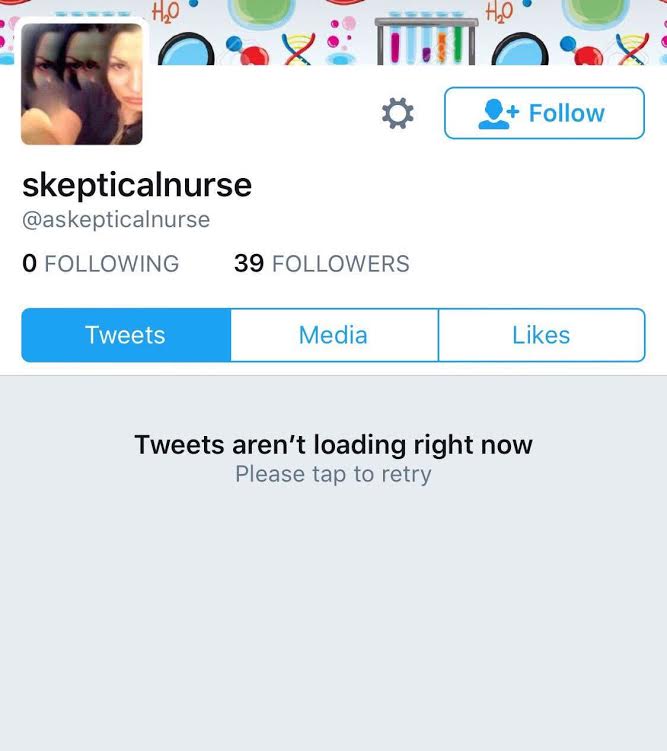
Skeptical Nurse materialized on Twitter not long ago, and disappeared almost as quickly.

Well known and aggressive GMO proponent, recent recipient of the Borlaug CAST Communication Award, guest on Skeptic's Guide to the Universe, The Joe Rogan Show and others, hailed by his boss as 'an agricultural scientist whose work has been compared to that of Neil deGrasse Tyson, Bill Nye, Carl Sagan,' Mr. Kevin Folta shared this new account with his followers about 15 hours before it went *poof!* into the ether of the interwebs:


Thanks to Notorious KGB Aggie, who decided to verify the qualifications of this account, it was revealed that the 'Skeptical Nurse' was really a woman who has worked as a cosmetologist with a delinquent CNA license.

The Florida Department of Health lists her license as having expired at the end of May, 2016.


As it turns out, this is someone Kevin Folta has been familiar with for some time (ahem ahem). He mentions Ms. Porozinski in this blog post back in 2010.

That blog of hers is now gone. In fact, all of Ms. Porozinski's social media accounts disappeared very quickly after it was made public that she is not in fact, a nurse, as she was calling herself. This is highly unethical - and outright illegal.


Three twitter accounts are now gone along with her Facebook profile, Skeptical Nurse page, both a Wordpress and Blogger blogs, and who knows what else. This is hella shady. These are the actions of a woman who engaged in deceit and got caught. This is a fake skeptic and a fake-ass nurse to boot. Yet, according to our friend Kevin, you should follow her for 'synthesis of diet and health claims -- and other stuff'.

Why, oh why, should we listen to these people for health advice? Do they think we are all stupid? If they would purposefully deceive us as to their degree and qualifications, what else are they being dishonest about?


Sunday, December 18, 2016

Fact Checking, Fake Skeptic Style!

Part 1 - Kevin Saves The World From The 'Activist Flyer'


Back in November, Food Democracy Now! and The Detox Project put out a report on lab results of glyphosate testing on popular food items. Vani Hari, aka Food Babe shared it on her website with the headline:


"Monsanto Is Scrambling To Bury This Breaking Story - Don't Let This Go Unshared!"

This prompted an article at Snopes by science writer Alex Kasprak. At first, the verdict was 'mixture', but that didn't last long. The Skeptics rode in on their science horses to correct Mr. Kasprak's miscarriage of justice. Kevin Folta in particular was very broken up over this particular Snopes piece and the FDN commissioned testing.


It seems that in Folta's mind, Kasprak's article had lent 'credence to the crazy claim' and so began a series of back and forth between them on social media and behind the scenes. As he had written in his blog, Folta was so sure that the tests were just a series of false positives, and the lab results are not peer reviewed because they could never survive peer review. 


Background noise! Methods incomplete! No evidence of replication! If it is not peer-reviewed, it does not count!

So, to recap - FDN and The Detox project released a report based on lab tests for glyphosate and AMPA (its major metabolite) in food samples. Food Babe shares it with dramatic headline. Folta cries that it's just fear-mongering and the results are meaningless. Snopes does a write up on it. Folta cries again. Folta sets the Snopes author straight. 

This all leads to the Snopes writer, Alex Kasparak changing the article to reflect Kevin's opinions. 

Still with me? There's more:

Folta then thanks Snopes for listening to 'science and reason' aka him. 

Pseudoskeptic Pseudoscience: dismiss what you dislike, then call it science and reason. Huzzah!


In his next blog post on the subject, he steels himself for retaliation (because martyr) from the FDN 'cult' and the 'wicked people in their defamation team', accuses a Twitter account of 'an obvious call for illegal hacking of my personal accounts' (they tagged @wikileaks in a tweet about Kevin - omg!) and awaits said retaliation, for he knew that commenting on 'the glyphosate brochure' 'would put me in the cross hairs of evil people with a mission to scare people about food.' After all these histrionics, something very interesting happens...

Background noise! Methods incomplete! No evidence of replication! ... oops.


Science is most certainly not about entrenching into a position based on ideology, and it would have served Kevin a lot better had he, oh, I don't know, contacted the laboratory himself for more info before passing judgement on the validity of their tests. Because indeed, there is no way he could have known that information, but he proclaimed his judgement regardless. So much so, they took the initiative to contact him. It seems as though they asked him to withdraw his unfounded criticism which we can probably assume is the reason for his above post. Despite this new revelation about the competency of the lab and their testing, Kevin comes to the conclusion that this whole exercise 'tells us two things'. One, that peer-review and complete disclosure is important, and two, that the levels are of absolutely no biological consequence. 

First, no one is going to argue that peer-review and complete disclosure are important, however, might I remind Kevin that the industry studies that glyphosate and other pesticide approval is based on are neither peer-reviewed, nor are they available for public viewing. So if he really believes that then he needs to begin a crusade to change that part of the risk-assessment process. As far as this type of testing is concerned, meaning testing of food for pesticide residues, when you look to the USDA Pesticide Data Program, their test results are also not peer-reviewed, and you must request information on testing for individual commodities - much like the FDA approved lab that performed the analysis for FDN. So, if it's good enough for the USDA, why hold FDN to a higher standard?

Second, Kevin seems very self-assured that these levels are of 'absolutely no biological consequence' and yet, all one needs to do is look at the literature to realize that this is an issue still being researched and debated within the scientific community. There are numerous independent studies showing hormone-mimicking effects at very low levels, and that issue alone needs to be thoroughly researched before anyone can conclude such absolutes. After all, as Kevin said, science is not about entrenching into a position based on ideology...

Part 2 - Fact Checking The Fact Checkers 

Snopes is often touted as the final word by many people and there's no exception to that within the Skeptic club.


Note how she qualifies it with 'regularly' - but let's be honest, you know are going to be mocked and derided as a conspiracy theorist should you disagree regularly or not. 

Snopes can be very useful if you want to know the legitimacy of the viral video of Cee Lo Green having a phone explode in his face, or say, if giving your dog ice water will really harm him like that blog post your Aunt Martha shared on Facebook says. These are simple straightforward questions with simple straightforward answers. 

Of course there are other questions that do not have simple, straightforward answers, and for these things is where it gets hairy. It's important to remember that Snopes is made of of just regular people who don't possess any special powers. The information they share as true or false or mixture, is only as good as their source. If that source is a Skeptic, you can be pretty much assured you will get the janky ass fake skepticism method demonstrated in part one of this post. 

Another issue that's quite noticeable with Snopes' fact checking methods is their tendency to form a question in a way that they can get a desired answer. 


We have an example of this here, with the ConfoundUp article, originally titled 'Monsanto Suppressing Cancerous Herbicide In Food?' before Folta raised a stink. Primary focus is on Food Babe and her headline, which to me, isn't even worth arguing over. Monsanto is not shouting these test results from the rooftop to be sure, but the real issue is the test results - and whether or not they are valid. The issue of impacts on human health are still in the stage of being investigated, and this is not the time to pass judgement on that. Regardless, this gets buried under an avalanche of 'conspiracy' and Ermagherd Ferd Berb said(!), with a big scoop of Folta's 'facts' on top. 
  
What is most important to note here is that even after being contacted by the laboratory (presumably because if someone just trashed your business with accusations of incompetence, malfeasance and fakery, wouldn't you contact them and tell them to cut the libelous shit?) and subsequently recanting publicly; 'I am comfortable they did the detection 100% correctly' (because wouldn't you cover your ass?) the Snopes article update remains exactly the same:


Note the contradiction here? Folta's statement is from Nov. 24


SO, WHY THE FUCK HASN'T SNOPES CHANGED THE ARTICLE TO REFLECT THIS NEW INFORMATION?