Featured Post

5 Astroturf Groups You Should Stop Sharing From

After a hefty helping of inspiration from blogger Dawn's Brain's series on Facebook pages that people need to stop sharing from, t...

Showing posts with label chemophobia. Show all posts

Monday, July 17, 2017

EDCs In The Mac n Cheese

It's pretty likely you've seen the New York Times article about phthalates in boxed mac and cheese products.


It's spurred numerous other headlines, and a few knee jerk reactions (more on that later).  A consumer advocacy group called the Coalition for Safer Food Processing & Packaging, commissioned testing of various brands and types of mac and cheese products. This group is led by a woman whose son suffered from a type of genital abnormality that can be caused by phthalates. She states, "my son was born with a birth defect called hypospadias with chordee – one of the most common among babies in the United States. At just eight months old, my son needed a three-and-a-half-hour surgery to dismantle and reconstruct his penis."

The group's choice to test mac and cheese products is based on research that dairy products are a significant source of phthalate exposure for infants and women of reproductive age. This review concludes:

"DEHP in some meats, fats and dairy products were found at high concentrations (≥300 μg/kg) in food monitoring surveys and significantly contributed to exposure in epidemiological studies. Similarly, assessment of daily dietary DEHP intake resulted in dairy as the highest contributor to exposure. Exposure estimates based on actual diets for infants exceeded the Environmental Protection Agency’s reference level while estimates based on high meat and dairy consumption resulted in exposure above this limit for adolescents. Some of the ADI’s developed by the CPSC for reproductive outcomes were also exceeded. We provide guidance on future research in this area to further understand food as an important phthalate source and to help identify methods to reduce dietary phthalate exposures."

Many studies have shown that phthalate contamination is common throughout the food supply, diet is considered a significant exposure pathway, and levels can be higher in certain foods than others. Additional research on phthalates suggests that it may bioaccumulate in some instances. In 2008 the National Academy of Sciences concluded that the EPA ought to be assessing phthalate toxicity using a cumulative risk assessment approach - because people are exposed to multiple phthalates. Some of these combinations have been shown to be more toxic combined than with isolated exposures. These combinations can be as toxic as a high level at low levels, even.

We do have some restrictions in place due to the known risks of exposure to phthalates in the US and other countries in some consumer products. Wouldn't it be awfully prudent then, that we should take measures to remove this contamination from our food supply, as well? It seems that this is exactly what the Coalition for Safer Food Processing & Packaging is trying to do with their testing and petition. 

Of course, rather than look at this evidence and say 'hey, if we can prevent painful genital surgery for babies, maybe we should really take a closer look at this and see what we can do to cut exposures' the reaction from Skeptics is unfortunately, predictable. 

Jenny Splitter wants you to 'calm the fuck down'


Kevin Folta wants you to know you're a chemophobe who won't die from eating mac n cheese

When all else fails, invoke the spectre of the Food Babe. OoooooOOOOOoooooo!

I'm not going to break down every detail of these articles but the arguments I've seen have been pretty similar, and pretty flawed - this is an activist organization, the testing wasn't peer reviewed (even though it was done correctly) everything is a chemical, zomg chemophobez, Food Babe, 'dose makes the poison', etc. But anyone who has done even just some cursory reading and looked at the scientific literature isn't going to fall for the 'it's all fear mongering everything's fine' tropes. While I fully agree some of the headlines are alarmist, this still isn't an unfounded concern.

And it's amazing to me that anyone would think that the impetus for this campaign is some random hatred for Kraft, when it's much more likely that watching your eight month old baby boy endure painful genital surgery is the motivating factor here. Is it wrong to want to prevent this and other harmful effects for others? Even yet, this doesn't stop Folta from calling this group shills in his article: 'shouldn’t they be calling themselves shills of themselves?' And he makes a big blunder with the statement, 'According to the logic of the report, Kraft manufactures this popular product with the intention of causing birth defects. Certainly you can see why Kraft would want that, because it is M&C is an obvious choice for children stricken with reduced limbs and fused fingers.' GENITAL ABNORMALITIES KEVIN. If you don't know enough to even correctly name the health effects these chemicals are being linked to - please sit down and shut up. Also, no one has accused manufacturers of purposely adding phthalates to food. So many of these ridiculous arguments are crafted from straw.

The response from the Skeptics has not been surprising to me, or probably a lot of you reading but it is once again illustrative of how they stand in the way of moving forward with science and applying it in ways that can help people who are suffering. And so often take the position that benefits industry over one that benefits the public.

I for one am not panicking over the boxes of Annies in my pantry, but I did sign this petition several days ago when I first saw it. This isn't a mac and cheese issue, this is a food production issue, one of public health, and making sure that we eliminate these cumulative dietary exposures that may be putting people at risk of harm. That feels quite reasonable and science-based to me.


Sunday, July 16, 2017

The Little Black Book of Junk

Our good friends over at American Council on Science and Health have shat out a new book called "The Little Black Book of Junk Science." Released on June, 29 with a star studded panel consisting of: 

Dr. Angela Logomasini, Senior Fellow at Competitive Enterprise Institute who specializes in environmental risk, regulation and consumer freedom. Her articles have also appeared in Wall Street Journal, NY Post and many more places.

Dr. Alan Moghissi, Long-time member of the American Council on Science and Health Board of Scientific Advisors, a charter member of the Environmental Protection Agency, where he was Principal Science Advisor for Radiation and Hazardous Materials; and Manager of the Health and Environmental Risk Analysis Program, and now Associate Director of International Center for Regulatory Science at George Mason University and President of the Institute for Regulatory Science.

Professor Nina Federoff,  Professor Emeritus at Penn State University, who was appointed to the National Science Board by President Clinton, was Science and Technology Adviser to U.S. Secretaries of State Condoleezza Rice and Hillary Clinton and was a recipient of the National Medal of Science from President George W. Bush. Among her many books is Mendel in the Kitchen: A Scientist's View of Genetically Modified Foods.

Dr. Alex Berezow, Senior Fellow in Biomedical Science at the American Council on Science and Health, frequent contributor to USA Today, Wall Street Journal and BBC, and author of Little Black Book of Junk Science and Science Left Behind.

L-R: Angela Logomasini, Alan Moghissi, Nina Federoff, Alex Berezow


It is appropriately named at least, with emphasis on "junk." I thought we could take a look at a few excerpts and have a cringe and chuckle.

Here are just some of the lowlights:

Second hand smoke? Pay no attention to the warnings from the CDC!


I have no idea what the fuck they're talking about here. Maybe themselves?

Fuck the ecosystem and those hippies with their science!

Hey, why blame the dealers when you can put it all on the addicts? It's complex!

No worries about 'low levels' of  PCBs! OK sure they bioaccumulate...


Except when they are an invention of Big Environmental! Oh, Hank.


The main goal of the Little Black Book of Junk Science seems to be to reassure all you irrational chemophobes about the safety of 2,4-D, atrazine, BPA, DDT, EDCs, flame retardants and the like. They go on to cite themselves no less than 26 times, as well as other highly regarded peer reviewed publications such as Forbes, Natural News, and David Wolfe dot com.

Once again, the ACSH prove themselves to be an agenda driven outfit, more concerned with industry interests than science or health. At least the title of their book was accurate.


Saturday, August 6, 2016

Do You Suffer From Chemophobia?

Have you heard? A great affliction is sweeping the globe! According to sources, a significant portion of the public is suffering from 'chemophobia' - being defined as an irrational or extreme fear of chemicals. Chemophobia is rampant and it threatens each and every one of us...or does it?

The way the word is being used, you'd sure think so.


I unfortunately did not have the pleasure of watching this ACS webinar,  but I think by taking a look at James Kennedy's blog, we can get the gist of what he was teaching there. Some of it I think is great and totally agree with - whereas other parts - not so much.

For instance, JK starts out strong:

"I ask all chemists to embrace the dictionary definition of ‘chemical’ and stop bickering with the public over definitions."

I absolutely agree that picking on people for using the colloquial term chemical is a waste of time, it will only serve to further polarize and makes you look like a jerk.

Now here is where things get hairy, as James goes on to define 'chemophobia':

"‘Chemophobia’ is an irrational aversion to chemicals perceived as synthetic.

The word ‘chemophobia’ refers to a small subset of people who are not only disenfranchised by science, but who have subscribed to alternative sources of knowledge (either ancient wisdom or – sadly – Google). Many people with chemophobia are protesting against the establishment, and this is particularly evident in the anti-GMO movement. At the core of most people who oppose GMOs is a moral/political opposition to having their food supply controlled by giant corporations. No number of scientific studies concluding the safety and reliability of GMO crops will succeed in persuading them otherwise because the anti-GMO movement is founded on moral/political beliefs, not on science. By throwing science at them, we’re wasting our time."

By using the word 'irrational' in defining chemophobia, it invokes a particular feeling. Irrational is defined as 'not logical or reasonable'. He then goes on to state that it refers to a small subset of people and uses the 'anti-GMO movement' as an example.

Mr. Kennedy has now entered weapon word and Celeber Cavilla Fallacy territory.

The Celeber Cavilla Fallacy

In one fell swoop, James has painted anyone who questions the use of genetic engineering and  companion industry chemical products in agriculture, as not just irrational, but unworthy of even being dignified with your time. Neutralized.


In the third section of his blog, James shares where the 20% figure comes from: The Royal Society of Chemistry’s report on Public Perceptions of Science polled just over 2 thousand people over age 16 on their perceptions of chemistry. So, using the results coming from this informal poll, Kennedy draws some conclusions.

"No matter how the RSC phrased the question, roughly 20% of the UK public who were surveyed indicated a negative attitude towards chemistry, and another 20% showed a positive attitude. The 60% in the middle felt disconnected from the subject – maybe disliked it in school – but felt neutral towards it when asked."

He then goes on to add:

"Chemophobia afflicts some people in the bottom 20%. They gave negative word-associations with ‘chemistry’ (e.g. ‘accidents’, ‘dangerous’ and ‘inaccessible’). That bottom 20% group is so vocal (e.g. Food Babe) that they distract chemists from the 60% in who are neutral. The ‘neutral’ crowd is a much larger audience that’s much easier to engage/persuade through outreach efforts. We should focus on talking to them."

Kennedy isn't clear about exactly how many he deems afflicted with 'chemophobia' - he just says it 'afflicts some' in the negative 20% - and then uses Food Babe as a scapegoat, I mean, an example.

He sums up his blog post with the idea that focusing on the 'neutral' majority is where chemists need to focus their efforts, and that if things go as planned, that the public may help them out in the fight against the enemy of 'chemophobia'.

"By engaging those who feel neutral about chemistry, we might even empower enough of the public to fight chemophobia (online, at least) by themselves – without our direct intervention."

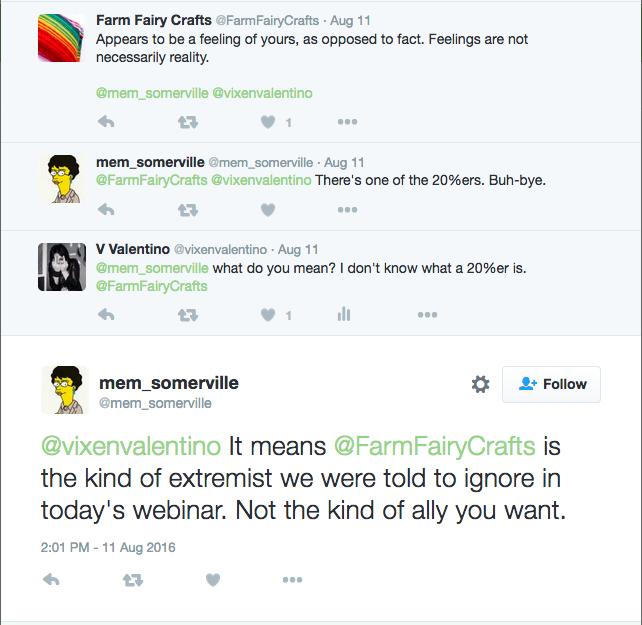
Now, despite not having personally viewed the webinar, I was lucky enough to be apprised of some of the highlights by my good friend mentioned above, Ms. Mary Mangan who tweets as @mem_somerville.  Credit goes to her for sharing all these lovely slides! Piecing this together with James Kennedy's blog post, we can get a better idea of what was being taught there.


While I agree that more science and chemistry education for the public is important, and that chemistry needs their own Brian Cox or David Attenborough, and that there are some very valid points being made here, what I can't abide is the use of pejoratives and (tired, played out) scapegoats.

Like a kid whacking at the same piñata for an hour... Seriously. Getting REALLY OLD, people.


The general public has every right to question the safety of manufactured chemicals without being described as extremists. At this point in time, the chemical industry has no one to blame but themselves for the lack of trust their unsafe products have inspired in consumers. Given that the testing and regulation of new chemicals is a joke, and the once 'safe' but now banned chemical list keeps growing, people are skeptical of manufactured chemicals for good reason. One very recent and egregious example is the trouble with perfluorinated chemicals, also known as PFCs for short.

An excerpt from a New York Times article about Rob Bilott, the lawyer who took on an environmental lawsuit against DuPont.

"DuPont pumped hundreds of thousands of pounds of PFOA powder through the outfall pipes of the Parkersburg facility into the Ohio River. The company dumped 7,100 tons of PFOA-laced sludge into ‘‘digestion ponds’’: open, unlined pits on the Washington Works property, from which the chemical could seep straight into the ground. PFOA entered the local water table, which supplied drinking water to the communities of Parkersburg, Vienna, Little Hocking and Lubeck — more than 100,000 people in all."

Bilott, speaking on the thousands of Dupont documents he went through for the case:

"DuPont had for decades been actively trying to conceal their actions. They knew this stuff was harmful, and they put it in the water anyway."

Chemophobia? To this I say please, dear chemical industry - GFY.