Featured Post

5 Astroturf Groups You Should Stop Sharing From

After a hefty helping of inspiration from blogger Dawn's Brain's series on Facebook pages that people need to stop sharing from, t...

Saturday, August 6, 2016

Censorship or Consequences?

On today's episode of Degrassi Junior High, a tempest is brewing at the Skeptic table over the removal of a Facebook page called We Love GMOs and Vaccines, which describes itself thusly;

"We are an organization devoted to promoting biotechnology and exposing those who wish to demonize it."

The page owner, Stephan Neidenbach is claiming his page has been censored via Facebook reporting. There is no way to know exactly who made reports or how many people made them. It seems the page was removed and then restored a few times prior to Facebook finally deleting it due to the number of reports.


This has led to a concerted attempt to get Facebook to restore the page under the assumption that it's being 'censored'.


Steven Novella from Skeptic's Guide to the Universe and Science Based Medicine has come to the defense of WLGV in a new blog post.

Recently the Facebook page, We Love GMOs and Vaccines, was permanently taken down by Facebook and its founder, Stephan Neidenbach, was banned from Facebook for 30 days. What offense did he commit to warrant such draconian treatment? None. He was simply using a Facebook page to promote a pro-science and skeptical attitude toward GMOs and vaccines, specifically to counter the gross misinformation about these technologies by anti-science fringe groups.

If you are going to defend someone and write a piece supporting them, best do some homework first and make sure that support is well placed. Shall we, then?

Is WLGV really some innocent babe in the woods, just trying to promote 'a pro-science and skeptical attitude'? Mr. Neidenbach has already accurately described his own behavior leading up to the removal of his Facebook page here in this now deleted blog titled dramatically; 'The Image That Brought The Queen of Anti-Vaxxers to Her Knees'. Lucky for us, it's in an online archive and you may view it in its entirety here.

This is regarding Erin Elizabeth, (girlfriend of Dr. Joseph Mercola) who runs a Facebook page called Erin at Health Nut News. Stephan describes how he attempted to 'bait her into action' with this insensitive meme making light of the suicide of Dr. Jeff Bradstreet.

Again, a day before the blog post was published Neidenbach is seen here bragging on Twitter about baiting Erin Elizabeth to Steven Novella's Science Based Medicine co-contributor David Gorski (@gorskon):


Note too, that Neidenbach references how he got around having his personal account put in time out:

"The image was unpublished by Facebook some time over night. Fortunately I used an alternate account to post the image, so my personal one was not put in time out by the Facebook “bots”."

He admits to using a sockpuppet account so he would not have to face the consequences for posting content that would be reported for violating Facebook community standards (the Bradstreet meme). This sounds like someone who knows full well what he is doing.

At some point after this the WLGV page was removed, presumed by WLGV admins to be by followers of Erin at Health Nut News. This led to one page admin asking for help from Kevin Folta.

Kevin advised them not to retaliate, and ended up having a dialogue with Erin Elizabeth. It resulted in Folta publishing a chastising blog post about the incident.


At first, it seemed as though the WLGV admins were taking his advice regarding frivolous reporting.


But it didn't last long.


Now, as far as Novella's claim that Neidenbach was 'simply using a Facebook page to promote a pro-science and skeptical attitude toward GMOs and vaccines', I present to you a sampling of WLGV posts made in between sharing other Skeptic blogs and links to American Council on Science and Health and Forbes articles:
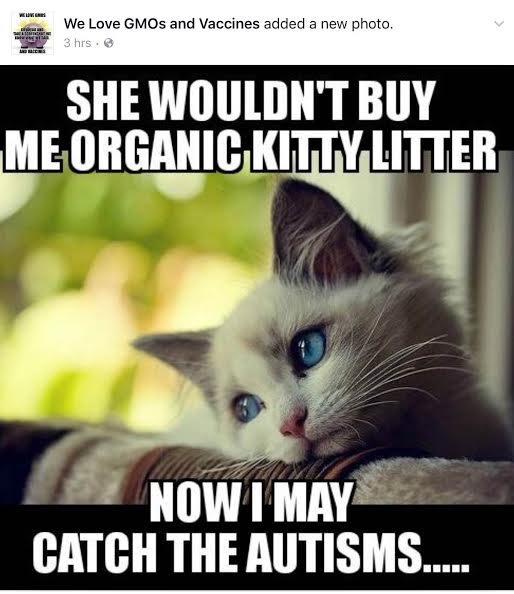
Making autism a punchline

Accusing sick people of faking for attention

In case you thought the first one wasn't clear...

Comparing people to Stalin and Hitler


Page founder encouraging fraudulent negative reviews in GMOLOL

And on WLGV


A new grocery store opens near you. What do you do? Destroy them, of course!


Did he even step foot in the store? Who knows...

Targeting Laura Krantz who wrote about Calsetous Juma's ties to industry in the Boston Globe.


Still here? Great, there's more!


Comparing GMO labels to Holocaust badges

Targeting Joseph Norman, postdoc at NECSI and co-author of the Precautionary Principle (with application the the Genetic Modification of Organisms)


Trolling the online Lyme community.

Edited to add the location in addition to the full name of organic farmer and Etsy shop Farm Fairy Crafts. WLGV doxxed them multiple times on Facebook as well as on Twitter.


The idea that WLGV was much of a science communication page to begin with, is a hard stretch of the imagination. They encouraged trolling and going after pages they did not like with negative reviews, and they frequently made personal attacks on people that the page creator, Neidenbach disagreed with. He even went so far as to create a 'Derp of the Month' series on the WLGV website to target individuals he does not like.


When Joan's daughter (naturally) defended her mother on Twitter, Neidenbach complained that Facebook had 'censored' him.

"The daughter of a quack peddling a juice diet to cure cancer, who I wrote about last week decided to take to Twitter in an attempt to “report” me. Apparently she finds it offensive that I called out her mom for encouraging people to starve themselves free of cancer. Since many groups hostile to science have a habit of attacking teachers, I made the graphic above as a hyperbole. The Zuckerberg bots just saw the flags and put me on a three day Facebook time out and removed the image."


None of this is science communication, clearly. So let's just put that to bed right now.

However, is this truly censorship as is being claimed?

Facebook is a free service - when you sign up, you agree to their set terms of service and community standards. Any violation of community standards will be removed. Facebook relies solely on reports to bring content in violation to their attention.


If WLGV were in violation of these standards or not was up to Facebook to decide - and decide they did as part of the agreement entered into by both parties. And whether or not there was a coordinated effort to report the page, one can begin to see that the page incited this type of back and forth. It really should come as no surprise to them that people eventually got tired of being a punching bag for the amusement of the page admins and their followers.

Despite this pattern of behavior, the Skeptics are out in full force defending the honor of their club members, all in the name of "free speech" and science. At the moment there have been several articles written aside from Steven Novella's mentioned at the start.

Kevin Folta: 'Silencing Unpopular Thought with Swarm Complaints',
Genetic Literacy Project hosted two: Science Communicators Condemn Facebook's Censorship of Pro-Science "We Love GMOs and Vaccines" and Stephan Neidenbach's account: Facebook bows to anti-science activists, shuts down ‘We Love GMOs and Vaccines’

Erin Elizabeth who had her page removed shortly after WLGV was deleted gives her account here: The Trolls Took My Page Down, We Won't Be Silenced and This is How to Get My Page Back Up 

In response to Health Nut News' removal, both WLGV and Chow Babe have unpublished their pages in protest of the situation.

Look, your Facebook page was removed. Your brother's scooter was not trashed by Hubie Pyatt, Mr. Pyatt did not try to molest you in the office, and you are not an 80's movie character - no matter how bad you want to be.


Not that I blame you for trying. But, maybe instead of all this drama of reporting pages, unpublishing pages, shouting censorship! with righteous indignation and grandstanding, perhaps people could oh, I don't know, start acting their age and be accountable for their online behavior?

Maybe if you have a page that says you 'love' something, you should promote that love instead of promoting hate for people who don't love the same exact things, the same exact way you do?

I know that's too much to ask for a lot of people, just like being sure that you if you are going to defend someone publicly that you first be sure they are not actually a bunch of immature cyberbullies who played a stupid game and are now stomping their feet crying because they don't like the consequences of their own behavior.

Do You Suffer From Chemophobia?

Have you heard? A great affliction is sweeping the globe! According to sources, a significant portion of the public is suffering from 'chemophobia' - being defined as an irrational or extreme fear of chemicals. Chemophobia is rampant and it threatens each and every one of us...or does it?

The way the word is being used, you'd sure think so.


I unfortunately did not have the pleasure of watching this ACS webinar,  but I think by taking a look at James Kennedy's blog, we can get the gist of what he was teaching there. Some of it I think is great and totally agree with - whereas other parts - not so much.

For instance, JK starts out strong:

"I ask all chemists to embrace the dictionary definition of ‘chemical’ and stop bickering with the public over definitions."

I absolutely agree that picking on people for using the colloquial term chemical is a waste of time, it will only serve to further polarize and makes you look like a jerk.

Now here is where things get hairy, as James goes on to define 'chemophobia':

"‘Chemophobia’ is an irrational aversion to chemicals perceived as synthetic.

The word ‘chemophobia’ refers to a small subset of people who are not only disenfranchised by science, but who have subscribed to alternative sources of knowledge (either ancient wisdom or – sadly – Google). Many people with chemophobia are protesting against the establishment, and this is particularly evident in the anti-GMO movement. At the core of most people who oppose GMOs is a moral/political opposition to having their food supply controlled by giant corporations. No number of scientific studies concluding the safety and reliability of GMO crops will succeed in persuading them otherwise because the anti-GMO movement is founded on moral/political beliefs, not on science. By throwing science at them, we’re wasting our time."

By using the word 'irrational' in defining chemophobia, it invokes a particular feeling. Irrational is defined as 'not logical or reasonable'. He then goes on to state that it refers to a small subset of people and uses the 'anti-GMO movement' as an example.

Mr. Kennedy has now entered weapon word and Celeber Cavilla Fallacy territory.

The Celeber Cavilla Fallacy

In one fell swoop, James has painted anyone who questions the use of genetic engineering and  companion industry chemical products in agriculture, as not just irrational, but unworthy of even being dignified with your time. Neutralized.


In the third section of his blog, James shares where the 20% figure comes from: The Royal Society of Chemistry’s report on Public Perceptions of Science polled just over 2 thousand people over age 16 on their perceptions of chemistry. So, using the results coming from this informal poll, Kennedy draws some conclusions.

"No matter how the RSC phrased the question, roughly 20% of the UK public who were surveyed indicated a negative attitude towards chemistry, and another 20% showed a positive attitude. The 60% in the middle felt disconnected from the subject – maybe disliked it in school – but felt neutral towards it when asked."

He then goes on to add:

"Chemophobia afflicts some people in the bottom 20%. They gave negative word-associations with ‘chemistry’ (e.g. ‘accidents’, ‘dangerous’ and ‘inaccessible’). That bottom 20% group is so vocal (e.g. Food Babe) that they distract chemists from the 60% in who are neutral. The ‘neutral’ crowd is a much larger audience that’s much easier to engage/persuade through outreach efforts. We should focus on talking to them."

Kennedy isn't clear about exactly how many he deems afflicted with 'chemophobia' - he just says it 'afflicts some' in the negative 20% - and then uses Food Babe as a scapegoat, I mean, an example.

He sums up his blog post with the idea that focusing on the 'neutral' majority is where chemists need to focus their efforts, and that if things go as planned, that the public may help them out in the fight against the enemy of 'chemophobia'.

"By engaging those who feel neutral about chemistry, we might even empower enough of the public to fight chemophobia (online, at least) by themselves – without our direct intervention."

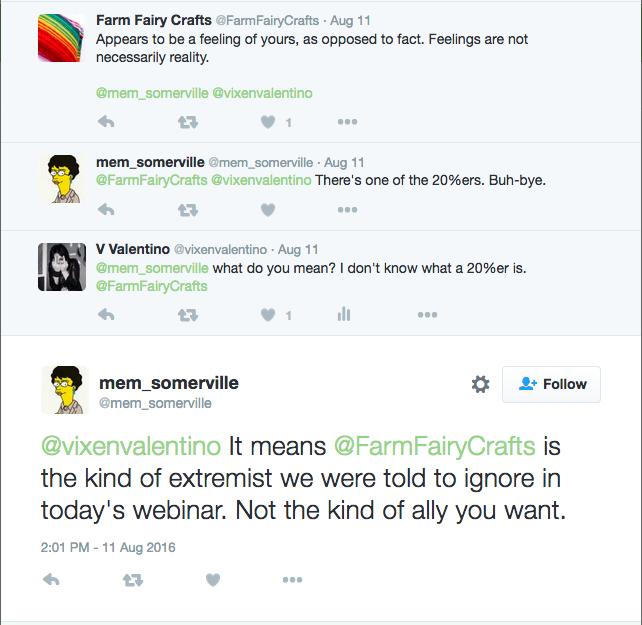
Now, despite not having personally viewed the webinar, I was lucky enough to be apprised of some of the highlights by my good friend mentioned above, Ms. Mary Mangan who tweets as @mem_somerville.  Credit goes to her for sharing all these lovely slides! Piecing this together with James Kennedy's blog post, we can get a better idea of what was being taught there.


While I agree that more science and chemistry education for the public is important, and that chemistry needs their own Brian Cox or David Attenborough, and that there are some very valid points being made here, what I can't abide is the use of pejoratives and (tired, played out) scapegoats.

Like a kid whacking at the same piñata for an hour... Seriously. Getting REALLY OLD, people.


The general public has every right to question the safety of manufactured chemicals without being described as extremists. At this point in time, the chemical industry has no one to blame but themselves for the lack of trust their unsafe products have inspired in consumers. Given that the testing and regulation of new chemicals is a joke, and the once 'safe' but now banned chemical list keeps growing, people are skeptical of manufactured chemicals for good reason. One very recent and egregious example is the trouble with perfluorinated chemicals, also known as PFCs for short.

An excerpt from a New York Times article about Rob Bilott, the lawyer who took on an environmental lawsuit against DuPont.

"DuPont pumped hundreds of thousands of pounds of PFOA powder through the outfall pipes of the Parkersburg facility into the Ohio River. The company dumped 7,100 tons of PFOA-laced sludge into ‘‘digestion ponds’’: open, unlined pits on the Washington Works property, from which the chemical could seep straight into the ground. PFOA entered the local water table, which supplied drinking water to the communities of Parkersburg, Vienna, Little Hocking and Lubeck — more than 100,000 people in all."

Bilott, speaking on the thousands of Dupont documents he went through for the case:

"DuPont had for decades been actively trying to conceal their actions. They knew this stuff was harmful, and they put it in the water anyway."

Chemophobia? To this I say please, dear chemical industry - GFY.


Sunday, July 24, 2016

The Uninformed Parent

I briefly alluded to this subject in the update to my last post about science communicators, and would like to elaborate more here. A few weeks ago, an important scientific consensus statement was published in the journal Environmental Health Perspectives.

According to the authors, the TENDR Consensus Statement is a call to action to reduce exposures to toxic chemicals that can contribute to the prevalence of neurodevelopmental disabilities in America’s children. They cite the increase in developmental disabilities like learning disabilities, ADHD, autism, and other developmental delays that are now affecting 1 in 6 children in the United States. This is an increase of 17% percent over a decade ago.

The scientists then go on to highlight the huge economic burden of these disorders, the unique vulnerability of the developing brain to environmental exposures, and they list some prime examples of neurodevelopmentally toxic chemicals...

Credit: Graphic by Julie McMahon

 ...they also note that the majority of chemicals on the market today have not been tested for neurodevelopmental effects, and underscore the need for a new approach to evaluating chemicals. In their conclusion they stress that the system we have in place is 'fundamentally broken'.

"Based on these findings, we assert that the current system in the United States for evaluating scientific evidence and making health-based decisions about environmental chemicals is fundamentally broken. To help reduce the unacceptably high prevalence of neurodevelopmental disorders in our children, we must eliminate or significantly reduce exposures to chemicals that contribute to these conditions. We must adopt a new framework for assessing chemicals that have the potential to disrupt brain development and prevent the use of those that may pose a risk. This consensus statement lays the foundation for developing recommendations to monitor, assess, and reduce exposures to neurotoxic chemicals. These measures are urgently needed if we are to protect healthy brain development so that current and future generations can reach their fullest potential."

This is a very strong statement and it conveys a message of urgency to the general public, regulatory agencies and scientific community. It has received coverage on major news outlets like the New York Times and CNN.

So, where are the #ScienceMoms on this one? Where are the Grounded Parents bloggers? Where are the authors of the 'The Informed Parent'? All of these people claim to be evidence based...and is it not their job to report on topics related to children and parenting? You would think this would be right up their alley? All parents are interested in protecting their children's health, so it's certainly not a topic that their readers and followers won't relate to. This is as good a reason as any to promote scientific evidence - which is what these ladies say they are so passionate about!

A cover photo from one of the #ScienceMoms' social media pages.

Because this was such an important statement with implications for the health of future generations, I wanted to be sure that the cadre of #ScienceMoms were aware of its existence. So, I tagged all the moms, bloggers and Forbes contributors I could think of off the top of my head, and that could fit in this tweet.


Honestly, my hopes were low that I would receive a response, and indeed my expectations were met for the most part. I certainly don't wish for this, it is far more important that this issue receives the attention it deserves than for my suppositions about mommy bloggers and their biases be proven. Truly, I would have been very happy to have the statement acknowledged and reported on by these ladies, who collectively reach a decent size audience. In fact I was very much wishing to be proven wrong!

Unfortunately this was not the case. If it weren't for a cynical tweet from @FarmFairyCrafts poking the bear a bit, I probably would not have ended up with this one response from Emily Willingham, the co-author of the book 'The Informed Parent' with Tara Haelle.


I did press her further for some kind of a straight answer...


and one last time...


So, despite some of them being given an opportunity to acknowledge this, I can't seem to find any mentions of this consensus statement on their respective social media platforms. What I did find was a peek into what these hashtag Science Moms do promote, which may explain why my tweets were met with crickets and tumbleweeds.


Concern about toxic chemicals is chemophobia?

We have livers, therefore chemical exposure is basically a non issue?

Confusing consensus with concillience, but even then, one would think they'd be more interested in an actual consensus statement?

Ahhh, so it's just better diagnosis, nothing to see here, or here, or here, or here, move along?

Not labeling GE ingredients takes center stage over children's neurodevelopment?

Again, this is what they are fighting against?


I did find this one glimmer of hope! Then I read the comments. Enter Debbie Downer: Wahhh waaaahhhhhhhh.


While on my search for any sign of the TENDR consensus statement, I found a Grounded Parents post advocating against GMO labeling. It was put together as a statement from Science Moms to celebrity moms. Oddly enough, one of the signatories just happens to be the director of a well known toxic chemical defending, climate change denying astroturf group, which I've detailed here. I guess they let it slide since she loves GMOs?

Judging by the sheer number of GMO related posts and this statement, fighting against GMO labels seems to be a main focus of many of these mothers, most specifically the Science Moms. They seem to be inordinately preoccupied with promoting GMO agriculture...and also just happen to be friends with the Director of Millenial Engagement for Monsanto Company, who claim almost 1/4 of the market share on GE seeds.


My friend Vance!

One can't help but wonder if this has anything to do with something that was in the emails revealed in this New York Times article about industry enlisting academics in lobbying against GMO labels?

Which came first, the chicken or the egg?

And again, something else of note in the trailer for the Science Moms documentary is this quote from Mommy Phd:

"If someone is talking about a synthetic chemical and calling it a toxin, you know they don't know what they are talking about, and then you shouldn't listen to them anymore."
video


So I'm assuming because someone uses the word toxin, when they technically should be using the word toxicant, then they are automatically unworthy of listening to? Honestly, who cares that much? This is like being all nitpicky over the use of the word chemical when synthetic is implied. I've personally seen the colloquial use of these terms by scientists. After all, they do need to make things simplified for laypersons. It's certainly okay to use things like that as a teaching opportunity, but if you use it just to put people down or make them look stupid, it's pretty fucking snooty if you ask me. What if someone were to warn her of a "poisonous" snake under a rock she is about to put her hand on? Would she argue over semantics with them? "Well, you don't know what you are talking about and I'm not going to listen to you because snakes are nearly always venom...ouch!"

The TENDR consensus statement mentions both synthetic and naturally occurring chemicals known to harm brain development, and they do use correct terminology, so at least they pass Mommy Phd's litmus test for whether or not they should be listened to. Phew!

All these clues would explain at least in part why I cannot find any mentions of the TENDR consensus statement. When taking these details into context, we start to get a better picture of what the Science Moms are all about. Unless you can access someone's mind, or they volunteer the information, you can't ever really know what their motives are and so I can only speculate on them here. Perhaps one reason they are remaining quiet regarding the statement is that it directly contradicts many of their core positions on chemicals and autism spectrum disorder (ASD), for example. It's also evident that more often than not, these women take the industry position on nearly all matters. Why that is, I cannot say for sure. But it leaves you wondering given the company they keep (Julie Gunlock of IWF, Vance Crowe of Monsanto, etc.)... Whatever the reason, their silence on this important matter is deafening.


Bottom line here is that there's no good reason why they should not care about this information and not share it with other parents. If you truly want to be an Informed Parent, I suggest you follow someone other than the so-called Science Moms.


Friday, July 8, 2016

Science Communicators - Legit or Bullshit?

There are a whole crop of people calling themselves 'science communicators' these days. They have blogs and Facebook and Twitter pages, some do interviews and write articles. On face value this seems like a positive thing and I think we can all agree that the general public can certainly benefit from more science education, formal or informal. Scientists can have a great impact by promoting knowledge that can help people live better, promote awareness of critical issues such as climate change, and make scientific learning more interesting and accessible to the general population.

Science communication done right, by qualified scientists who educate according to their field of expertise is a wonderful thing. There are quite a few of them out there. But, poorly done science communication is going to cause more harm than good. Misinformation by itself is bad enough, but misinformation masquerading as science by people who think they are competent to speak authoritatively on a range of subjects can be devastating. Misleading the public under the guise of being evidence based or aligned with the scientific method is criminal. It can undermine trust and lead to profound ignorance. This is how monsters are created.


More on this at the end of the post...


Unlike many of the easily recognizable internet personalities and websites that spread potentially harmful advice (generally peppered with some harmless feel-good information or memes), there are those that claim to represent science who cloak themselves in a shiny veneer of 'logic' 'reason' and 'evidence', while being anything but. This is particularly true of the Skeptic movement. These people are fraudulent pseudoscience communicators. They are not communicating what being truly skeptical means, modeling appropriate logic, or giving people the tools to think both critically and independently - despite purporting to. Instead, they are merely projecting an image of these things for their own personal gain, whether it be influence, celebrity, accolades or career opportunities. Some may even be directly compensated monetarily for promoting industry views. A great deal of them have no actual science training, though they certainly don't let that get in the way of their ambitions.

How then, do we recognize the frauds masquerading as legitimate science communicators? By applying some basic scrutiny, and looking for behavioral patterns.

We can start by asking questions:

Are they focused on debunking rather than teaching?

Is there an us versus them club mentality? (Anti- whatever vs Pro)

Do they portray anyone not adhering to club rules as stupid?

Are they inordinately focused on self promotion?

Do they exhibit narcissistic traits?

Do they compulsively belittle others?

Do they focus on the person instead of the issue?

Do they depict anything without a clear answer, or yet investigated by science as woo or already debunked?

Do they promote a personal religious agenda by using science as leverage, stuffing beliefs into science tenets, blurring lines of dogma and science and enforcing atheism?

Are they overly competitive?

Do they exhibit hatred/anger?

Do they justify unethical behavior by their position, or as a means to an end?

Do they justify unethical activity by followers or turn a blind eye?

Do they send followers to attack others viewed as the enemy? (#shillarmy)

Do they intentionally deceive others in the name of science?

Do they place all burden of proof on others? (citation, please!)

Do they require proof to be established immediately?

Do they misuse Ockham's Razor?

Do they misuse the Dunning-Kruger effect to their advantage?

Do they publicly vilify people outside their club?

Do they characterize those who have opposing ideas as intellectually inferior, brainwashed, or irrational?

Do they characterize everyone outside their club as all having the same beliefs and citing only extremes as examples? 

Should you notice even a few of these answered in the affirmative, it should be big red flag that the information you are getting is not coming from a capable source.

Now, more on our photo from above.

A popular 'science communicator' who shall remain nameless, (okay it was SciBabe and I know, you're shocked - but I swear I started this blog prior to stumbling upon such a fantastic example!) made a post about a Detroit Free Press article the other day:

"I just got an email titled "I think your followers just took on the Detroit free press."
The comments on this post are so delightful. The internet seems to have collectively figured out that detox is not a thing, at least for today. Go read for some faith in humanity. Or at least this corner of the internet.
Is it my birthday soon or something?"

She finds the 80 some-odd comments on this article delightful. The top one being...

Some of the "no science to support the existence of 'toxins'" is found here.

This, my friends, is the result of garbage science communication. This is the monster that thinks its 'science literate' that goes around repeating things it heard from Skeptical Scooby Doo or some other ridiculous poseur. The monster that bludgeons you over the head with its 'knowledge' while failing to realize it is everything it claims to be fighting against. The irony is just too much.

Now, keeping in mind the questions from above, please note the reaction from our science communicator when someone positions themselves outside of the club by disagreeing with the assessment of the article.

SciBabe communicates science. 

I sure feel like a lot of scientific knowledge was imparted there, don't you???

Now, was the article in question really a giant flaming missile of woo as is being claimed? 

Here's an excerpt:

"Will a juice regimen, fast, or cleanse solve this problem and renew and revitalize your body? Sadly, there is no pill or juice that will scrub your insides clean and reverse the effects of bad lifestyle habits.
If you really want to lose weight, gain energy and feel better, consider making the following eight lifestyle improvements. While these are not miracle cures, consider these as steps on the path toward healing."

After this they list off some common sense measures to care for one's health. Adequate sleep, healthy foods, exercise etc.. They even refer to detox as being a buzzword in the beginning of the article. Was it 100% accurate on every point? I don't know, I have no desire to sift through and research every bit of it. I see no advice in there that will cause anyone imminent danger or harm, and so I feel no need to warn anyone away from it. The barrage of comments seemed both misguided and completely unnecessary. Those people were there to enforce club rules, not to think independently.

This is yet another example of the typical knee-jerk reaction from Fake Skeptics when you say either the word 'toxin' or 'detox'. They turn into frothing wild beasts at the mere mention of these forbidden words. "David Avocado Wolfe says toxin and detox! Pseudoscience! Avocados!  Arghhhhh!...!@#$%^&*....(unintelligible)...."

Nobody is being led to believe this dirty hippie is a scientist, no matter how many of his inspirational quote memes they share on Facebook.


This guy might be utterly full of shit, but he's not the one claiming to represent science! 

Let this be a lesson to us all on whom we choose to follow. Fraudulently claiming to represent science can create more a more insidious form of science illiteracy than the folks who are spreading the woo woo.

UPDATE: It looks like Yvette felt it was worth her time to sift through the article in question and critique it using online annotations. Meanwhile, we have dozens of legitimate scientists releasing a consensus statement on toxic chemicals and children's neurodevelopment, and SciBabe remains mute. For someone who is so interested in anyone who says the word toxin, she's sure quiet on this one...

But, in her world, debunking this article is a priority. Here are two of her notes. Other than one link to the FDA website, she offers no citations for her opinions, despite giving the author epic shit for it.


If SciBabe were to take a middle school biology course on organ systems, she would fail this unit. In addition to liver and kidneys the lungs, skin and digestive system all help remove toxic chemicals from the body. Yes, you can sweat out toxic elements, heavy metals specifically have been shown to be excreted this way as well as Bisphenol A and some phthalate compounds.

Yvette's hatred for all things detox are getting in the way of some really basic information and no amount of snark can cover the fact that she's not what you'd call an expert on this topic. This isn't what science communication is supposed to be.

Now excuse me while I go detoxify.*


*I'm going to go pee.


Sunday, June 12, 2016

I Looked For "The Store"!

I don't know if you've seen this meme floating around, but it's frequently used by many fake skeptics when trying to shut down an argument, or simply to troll people if anyone happens to share a link from one of these sites.


It comes from a Skeptic Facebook page called Refutations to Anti-Vaccine Memes. I've noticed this used even when the topic at hand is not vaccines, as it seems to be used to discredit these sites with the argument that they are just trying to sell you something. I definitely think it's fair to be skeptical of that, and each one of these websites used as examples would need their own discussion to ascertain whether or not the information found there is generally reliable, of course.

I think it's interesting that they are making the assertion that 'pro-science' sites are 'just trying to give you the truth.' Since so many Skeptics claim to be pro-science, evidence based and refer to  themselves as 'science communicators', I decided to apply the same reasoning to their own websites.

Lo, and behold - look what I found!


They have stores! Shops! T-shirts and affiliated books to sell! Oh, my!

The question I am left with is why is it okay for them to have a store, and for them to sell things, but not okay for others? That feels fairly hypocritical.

This is not to say, that I think selling something automatically discredits someone. I do think you need to base it on more than that, and the argument - look for the store! - is not a very effective one.

Some fallacies that apply here:


Bias Blind Spot – the tendency to see oneself as less biased than other people, or to be able to identify more cognitive biases and faults in others than in oneself.

Ingroup Bias Projection – when citing superior morality, rationality or intellect as traits more likely characteristic of members of one’s own group.
"Pro-science ones are just trying to give you the truth."


Ingroup Bias – the tendency for people to give preferential treatment to others, or the ideas of others they perceive to be members of their own groups.

Giving preferential treatment in this instance by using the existence of a store or product to discredit someone, while not applying it to your own group. The implication that it's okay for Skeptic websites to have stores, but not okay for ---> these people.


Inverse Argument from Authority – because it says something in Breitbart, Fox News, ad absurdum, therefore it follows that it’s false. Inverse of Argument from Authority, possessing the same flaw.

Using the meme to discredit an entire idea proposed as false because the website has a store - instead of addressing the idea itself.

"When in doubt just look for:  The Store™"


In conclusion, while it's always a good idea to be skeptical of anyone trying to sell you something, it's  important to apply that skepticism equally. That includes questioning those who claim to be pro-science, since they are just as likely to be selling something as anyone else. One can buy, sell, or receive compensation for what they do in many forms - it's not always just about money. Having a store - or not - isn't the best way to determine if a source is credible.